How Zendesk Became The Industry Leader And Hit $1030 Million Revenue In 2020

Miha D. Cacic
Published 24 March 2021
Updated 6 June 2022
In just 13 years, Zendesk went from a scrappy Danish startup to the industry leader in Customer Service Software. Today they have:
- 3500+ global employees
- 150,000+ paying customers
- $1030 million in annual recurring revenue (ARR)
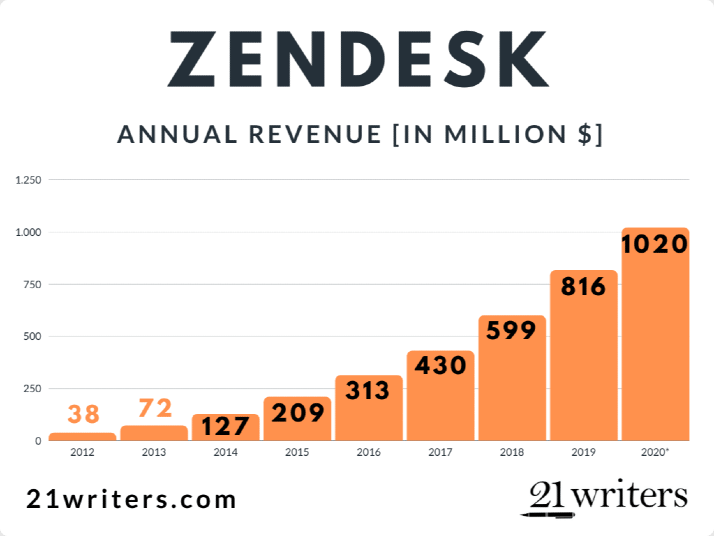
In this post, I’m going to show you exactly how Zendesk grew from $0 to $1030 million ARR and how you can use the same marketing principles in your own SaaS business.
Chris Von Wilpert, ex-Sumo for Noah Kagan, loved the analysis:

As did the owner of MailShake, VoilaNorbert, and Rightinbox who shared it… and hired me as his lead content strategist immediately after.

Now before we dig in, first grab my Zendesk marketing swipe file to see three additional marketing tips as well as all the tools that Zendesk uses in its marketing.
Then read on to grow your own SaaS business up and to the right.
TABLE OF CONTENTS
When it comes to growth, people at Zendesk know exactly what they’re doing and are known for their clairvoyant growth predictions. Here’s Mikkel Svane, Zendesk’s CEO, thanking his team in 2020 after reaching a $1B revenue run rate which he predicted back in 2016.
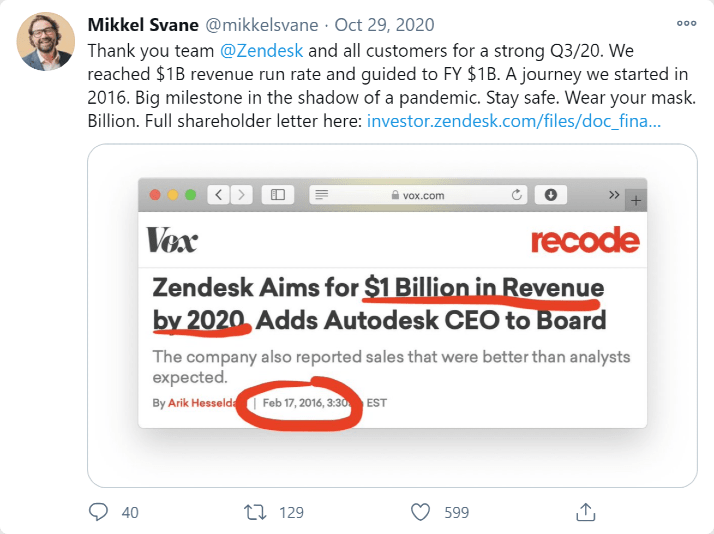
With such competent leadership, it’s no wonder that Zendesk has, in the last 5 years, increased its enterprise value more than twelve-fold: from $1.4B in 2016 to $18.1B in 2021.
But what’s interesting is that even though Zendesk completely dominates its market, it got that way without relying on aggressive marketing tactics.
Rather, with their sprawling blog, Zendesk is a master at nurturing and educating. Their Ahrefs Rank is 167 out of a million, which places them in the top 0.02% of the websites with the strongest backlink profile.

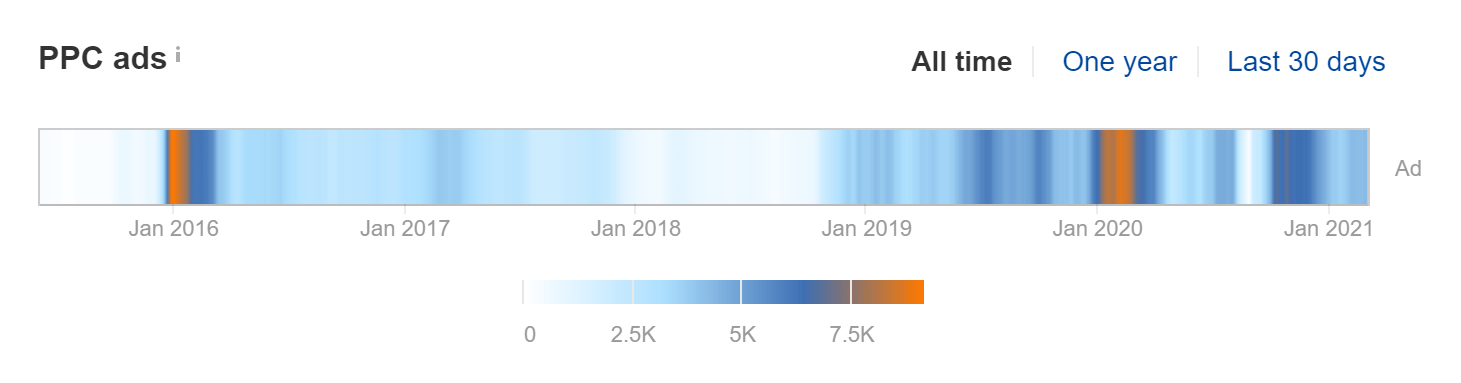
But they’re not chumps at PPC, either. Throughout its history, Zendesk was constantly running strong PPC campaigns. Even today they have more paid keywords than most big-name SaaS startups: including Hubspot, New Relic, Atlassian, and Intercom.
Zendesk has its flaws. But with its mix of PPC, content, pricing, and product strategy, Zendesk is nevertheless the prime example of how any SaaS company should grow.
So if you want to grow your SaaS business up and to the right then read on for a deep dive into 12 marketing tips from Zendesk.
Ready for it?
Let’s go.
TIP #1:
Pricing & Product Strategy
Smartly Priced Addons That Make Your Customers Beg To Give You Money; And A Sales Team That Takes It.
Many SaaS companies don’t realize that the biggest growth opportunity is not in customer acquisition or retention, but in price optimization.
In fact, a 1% improvement in price optimization increases your profits, on average, by 11,1%. [*]
Zendesk knows this, that’s why they optimized their pricing down to the teeth. And they tell you that as soon as you land on the product page:
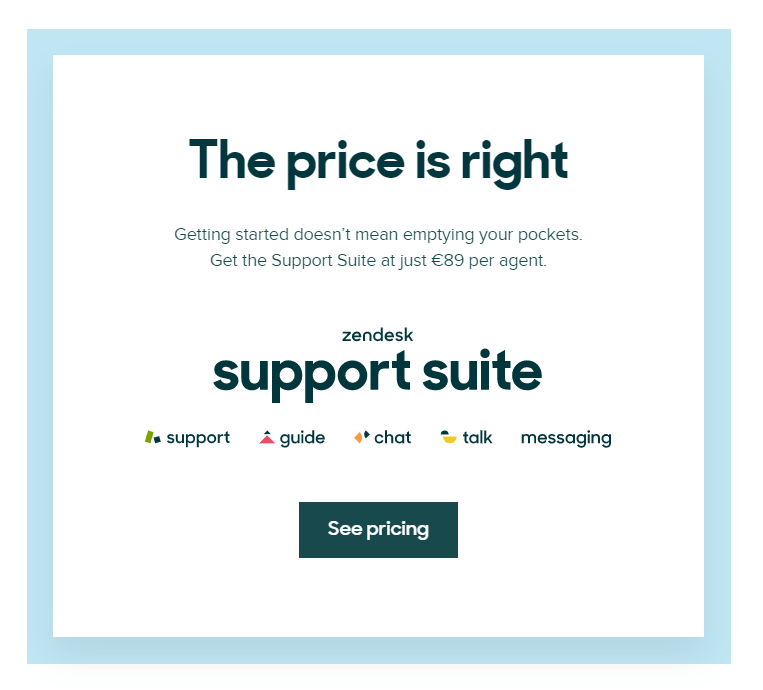
To prove that Zendesk puts a lot of thought into their pricing, let’s check a survey conducted by a SaaS pricing agency, profitwell.com.
Profitwell surveyed 5,211 current, former, and prospective Zendesk customers about how much they’re willing to pay for Zendesk Support — one of the core products.
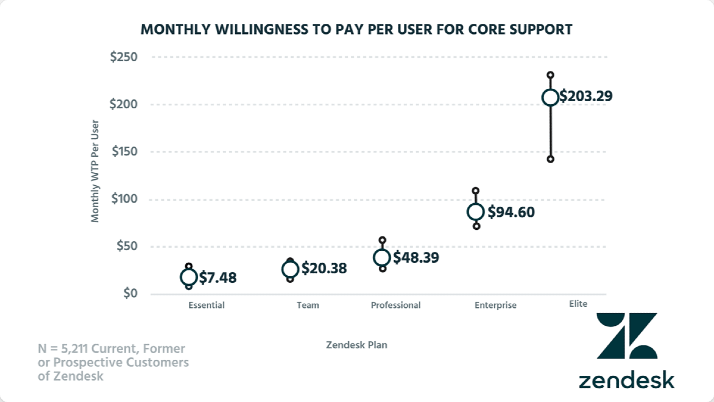
The curve mirrors Zendesk pricing perfectly:
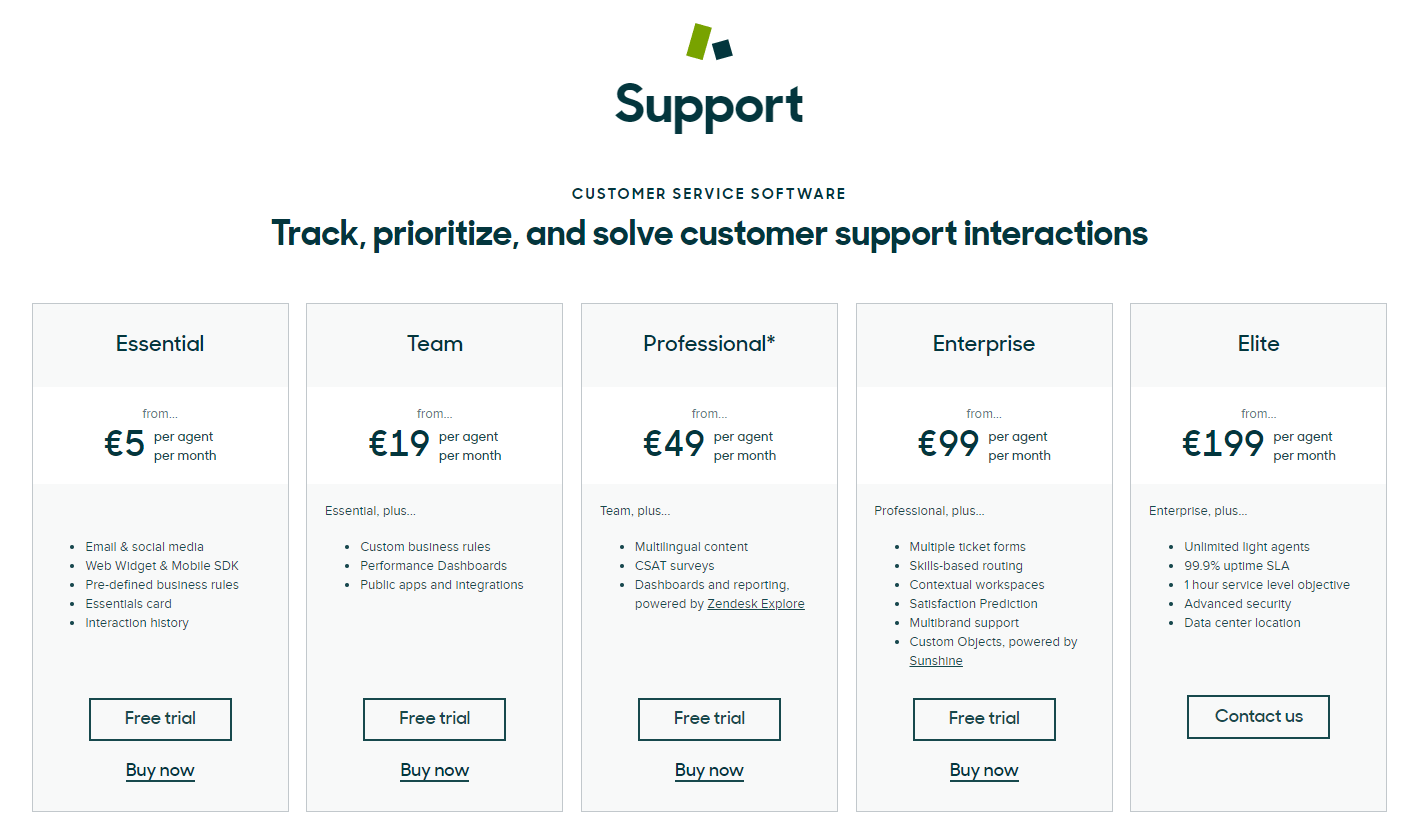
(In fact, Zendesk could, based on the research, increase the cost of their Essential package to $7.50 without a problem.)
PRO TIP: Your curve is going to be different depending on your market, buyer persona, and product. You should do your own research and follow things from there.
But hyper-optimized pricing is only one reason for Zendesk’s $1000M ARR.
Back when Zendesk was a one-product company, they noticed their ideal customers were underserved in more than just help desk software.
They capitalized on the opportunity by expanding their product line with a Sales CRM software called Zendesk Sell and many add-ons like Guide, Chat, Talk, Explore, and Gather.
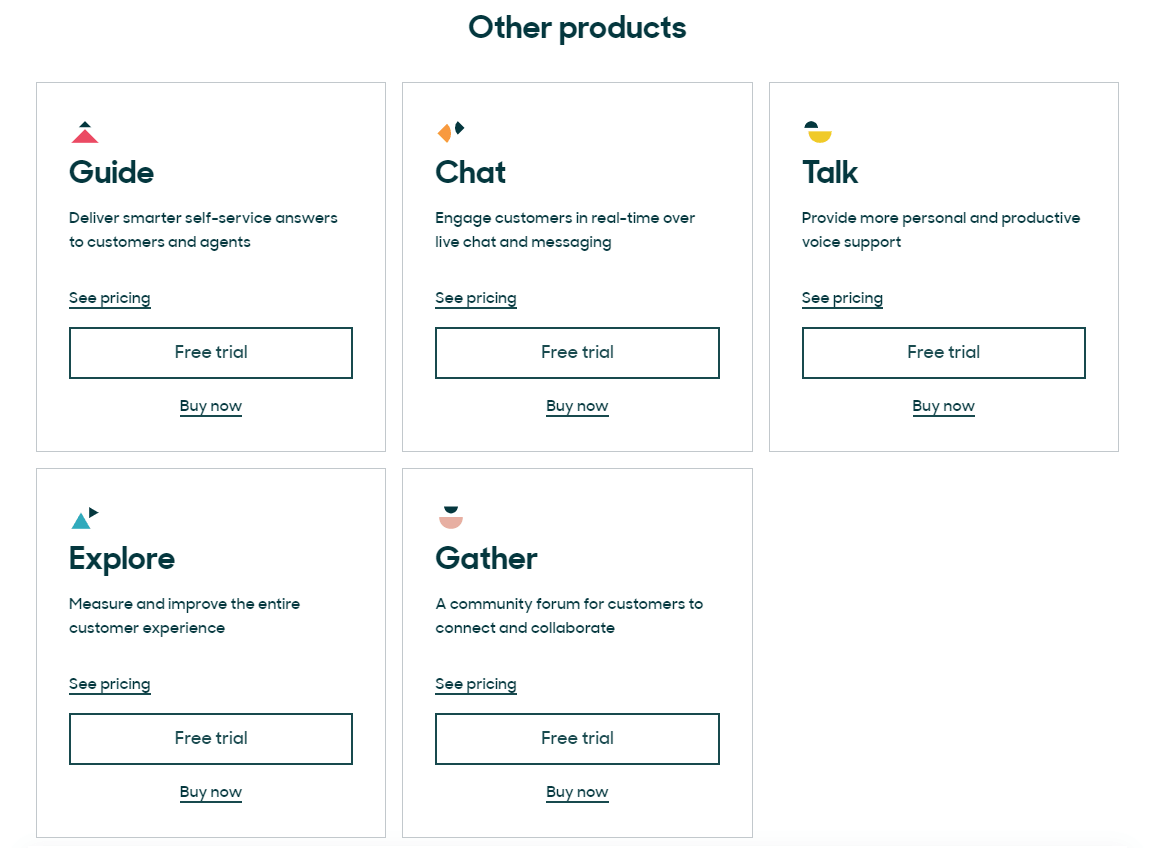
I call this Inward Expansion as opposed to Outward Expansion.
In Outward Expansion, your focus is on marketing, customer acquisition, and customer retention…
But in Inward Expansion, you’re increasing the value of your current customers with better customer experience, new products, and add-on upsells.
Why would you do that?
Because in the outward expansion business model, no matter how hard you try, your revenue will plateau.
You see, profit in account-based subscription services (like SaaS) depends on two things:
- How many customers you have
- How much money they’re giving you
But keep in mind that a portion of your customer base will leave every month. This is called company’s churn rate.
Since churn is relative, the more customers you have the more you’ll lose. But adding new customers is absolute — each acquisition costs a set amount of money (CAC: customer acquisition cost)…
This means you’ll have to spend more and more money offsetting bigger and bigger churn losses. Sure, you can try to scale your marketing, but even that will eventually collapse.
That’s why Zendesk shifted its focus from getting new customers to increasing the lifetime value (LTV) of existing customers.
To prove my point, this is how much an average Zendesk user was spending on Zendesk products from 2013 to 2020.
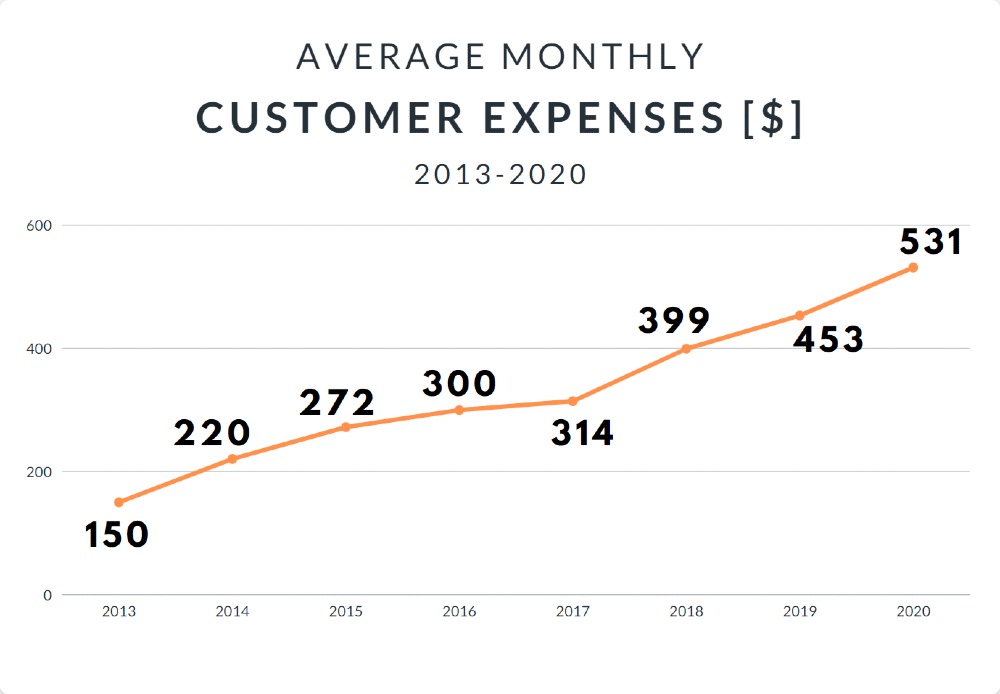
(During this time they also increased their customer base from 40k to 160k, so inward expansion is not the only thing you should be doing, of course.)
Zendesk knows that if their customers grow, they grow — because once their customers have a bigger spending budget, they’ll spend more on Zendesk’s services.
“Customers buy trajectories as much as they buy current features. They’re not just buying into the current product — they’re also buying into what the future of that product is going to look like.”
— Sam Boonin, VP of Product @ Zendesk
All Zendesk has to do now is develop useful products and add-ons and the cycle continues.
PRO TIP: If you’re just starting your SaaS company, focus on outward expansion first. Once you have a solid customer base, shift your focus to upselling current customers on new add-ons and products made just for them.
Before we wrap this chapter, there’s something we need to say about Zendesk’s sales team.
Having a great content strategy and online marketing is the key to successful Outward Expansion…
But marketing by itself can’t close big deals, create tailored solutions, or spot upsell opportunities — everything that’s crucial for Inward Expansion.
For that, you’ll need a sales department.
“At the beginning most of our sales came from our online business. A bunch of people came to our website, they would sign up for the product trial, and they would purchase online. While this strategy was sustainable at smaller sales volumes with a shorter sales cycle, we knew that growing the business meant spending more time on direct sales process and customer success channels.”
— Sam Boonin [paraphrased]
With 160,000 customers it’s no surprise that 2200 (or 68,7%) out of 3200 Zendesk employees are salespeople and account executives.
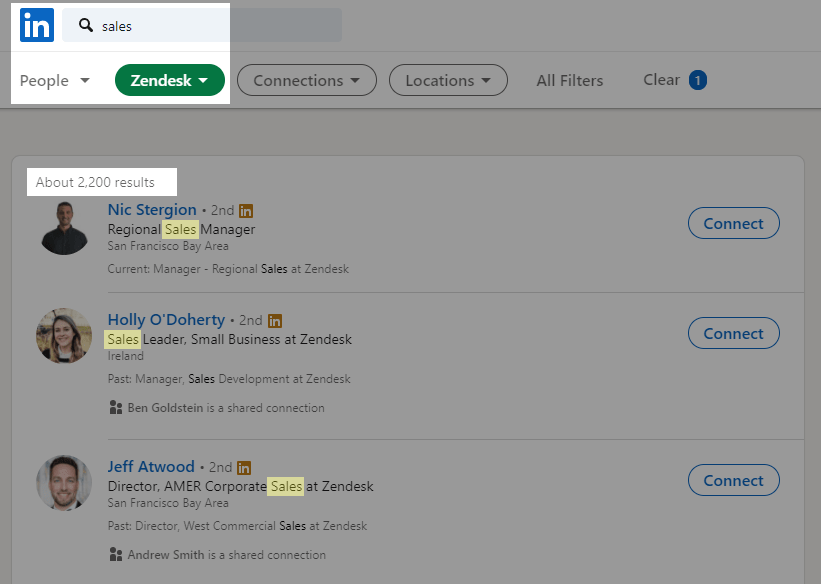
Based on my estimations, one Zendesk salesperson handles roughly 50 accounts and is responsible for, on average, $37,800 in monthly revenue.
I believe many new SaaS companies undervalue the power of a sales force. In the past few years, digital marketing positioned itself as the holy grail of any business. But marketing can only get you so far. Having a capable sales team is a must — especially if you’re selling high-ticket products or services.
FIRST KEY TAKEAWAY: Don’t undersell or oversell your product. Find the optimal price by researching the market and tweaking your price according to data.
SECOND KEY TAKEAWAY: When your marketing efforts begin to dwindle, start thinking about how you can add more value to your existing customers with new products and add-ons.
THIRD KEY TAKEAWAY: Get the most out of your customer base by hiring a sales team that can spot upsell opportunities, close bigger deals, or negotiate tailored enterprise solutions.
TIP #2:
Content Marketing Strategy
Rank High For Competitive Keyphrases By Grouping Your Blogs Into Hubs That Serve Only One Audience At A Time.
As of March 2021, Zendesk’s blog has over 2513 pages:
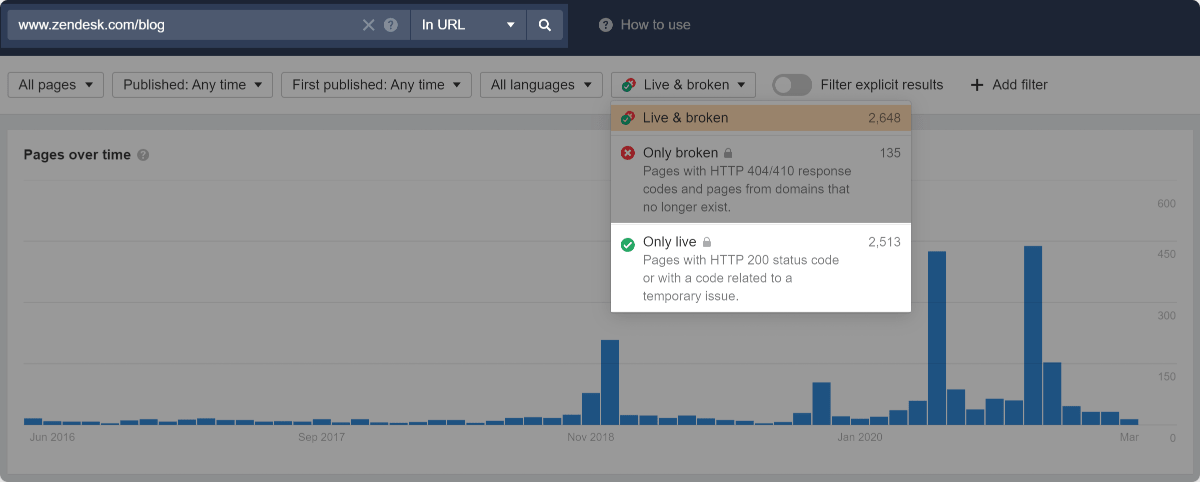
That’s a lot of posts, but Zendesk didn’t make them haphazardly.
(The spikes you’re seeing, where Zendesk published almost 450 posts in a single month, are the result of Zendesk moving posts from an old domain to zendesk.com/blog.)
Zendesk is using a powerful SEO-based content strategy called Topic Clusters.
A topic cluster is made out of a central content Pillar (also known as a Hub) and 3-20 Supporting Articles (also known as Spokes) connected by two-way hyperlinks like so:
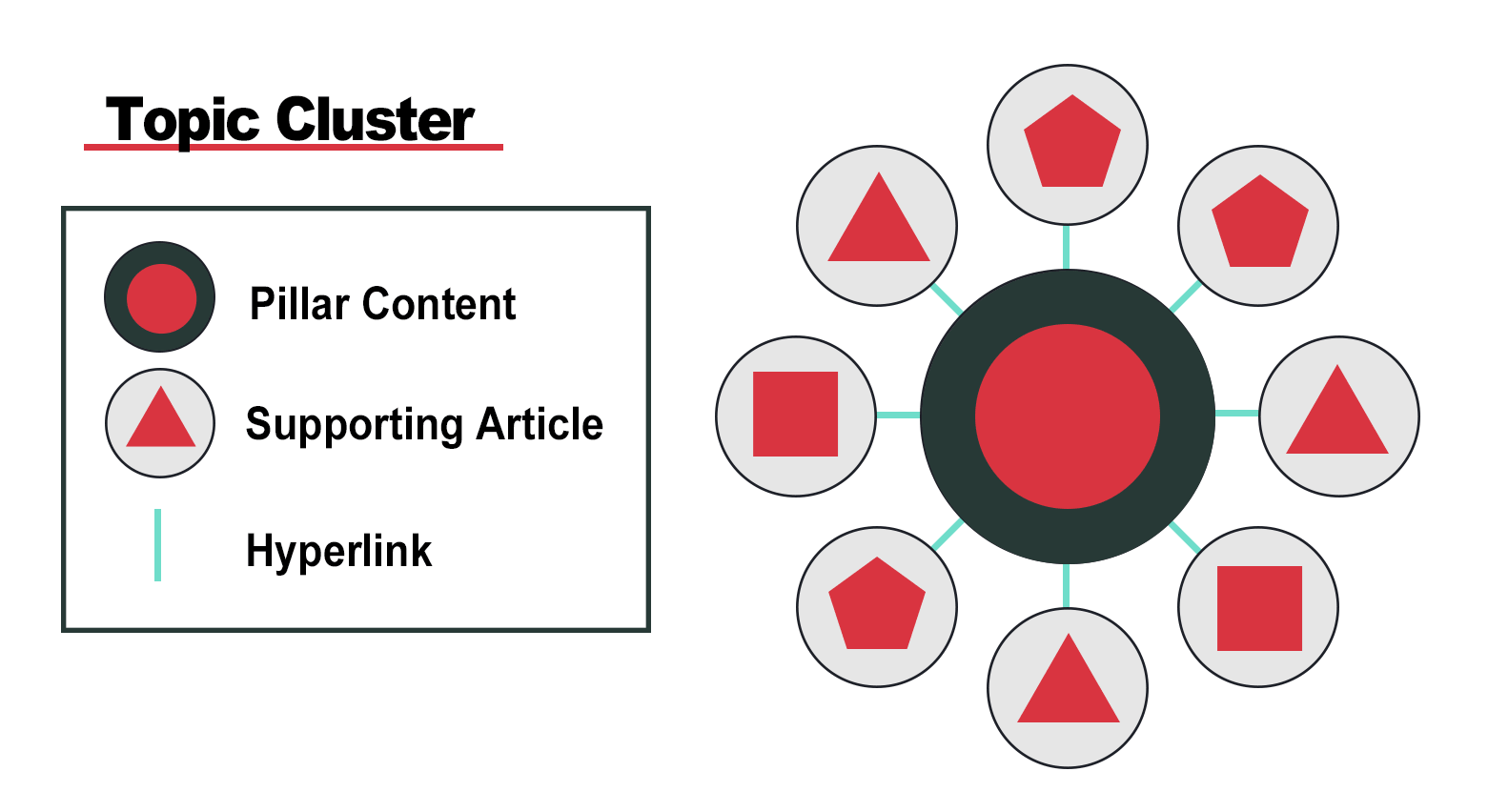
Each relevant content piece in a Topic Cluster is thematically connected and serves only one audience.
Because of this, Google will, to hyper-satisfy the search intent, improve the ranking potential of every post in your Topic Cluster.
This is the reason why Zendesk outranks its competition for difficult terms like customer service, sales crm, and help desk.
If you don’t believe me just look at Zendesk’s top performing blog posts…
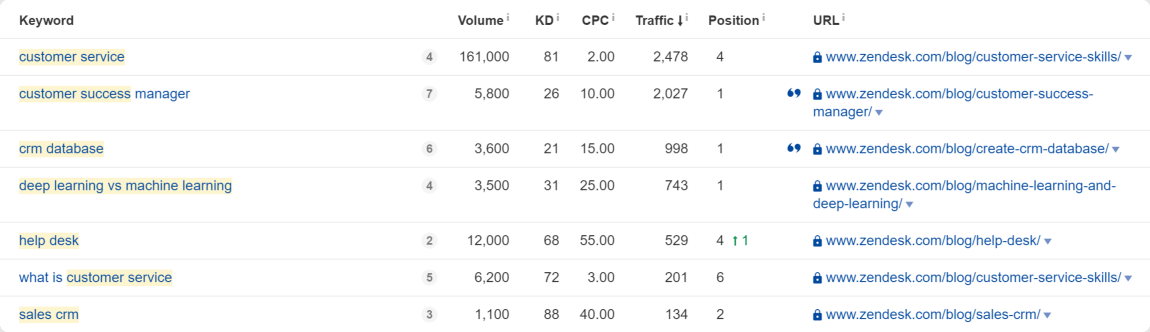
and notice the high position, traffic, and keyword difficulty (KD).
(On top of that, all these keywords are highly related to Zendesk’s products — meaning that the traffic quality is very high.)
So how does Zendesk create a topic cluster?
Zendesk starts by identifying the target audience: which is, in Zendesk’s case, the same audience that’s already using their products.
Zendesk then creates the Pillar: a highly educational piece of long-form content introducing the main topic. Here’s an example of a Pillar from Zendesk’s most popular Topic Cluster, Customer Service:
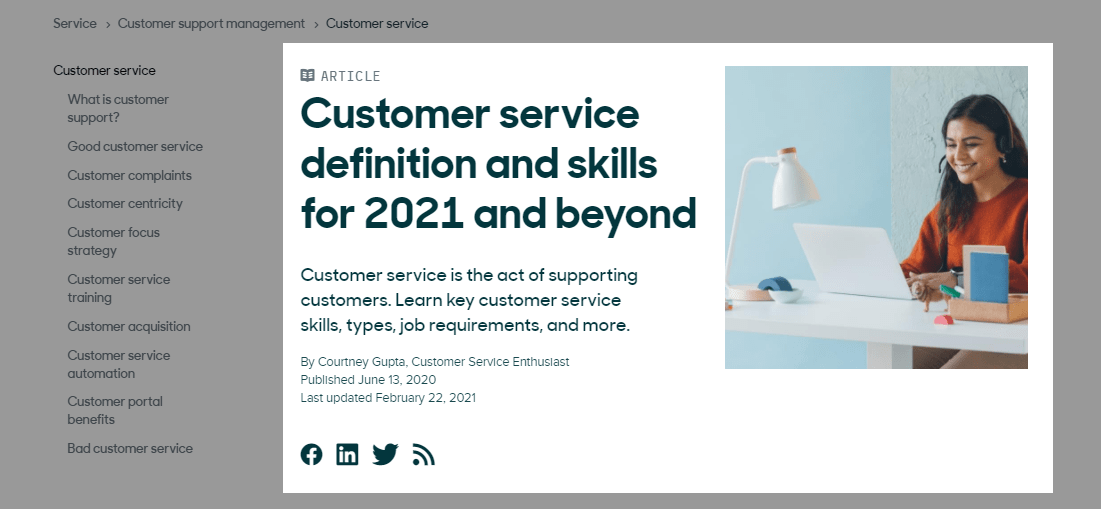
- Increase time-on-site,
- Rank for more keywords,
- Stand out from the competition,
- Entrench their Google Rankings.
Because these are huge articles with lots of images, loading time is a big issue. Click here to reveal the tool Zendesk uses to improve loading times and page speed.
Zendesk then proceeds to create as many supporting articles as needed to cover every single aspect of the topic.
In the case of Customer Service, these are topics like customer service automation, customer service training, and what is customer support.
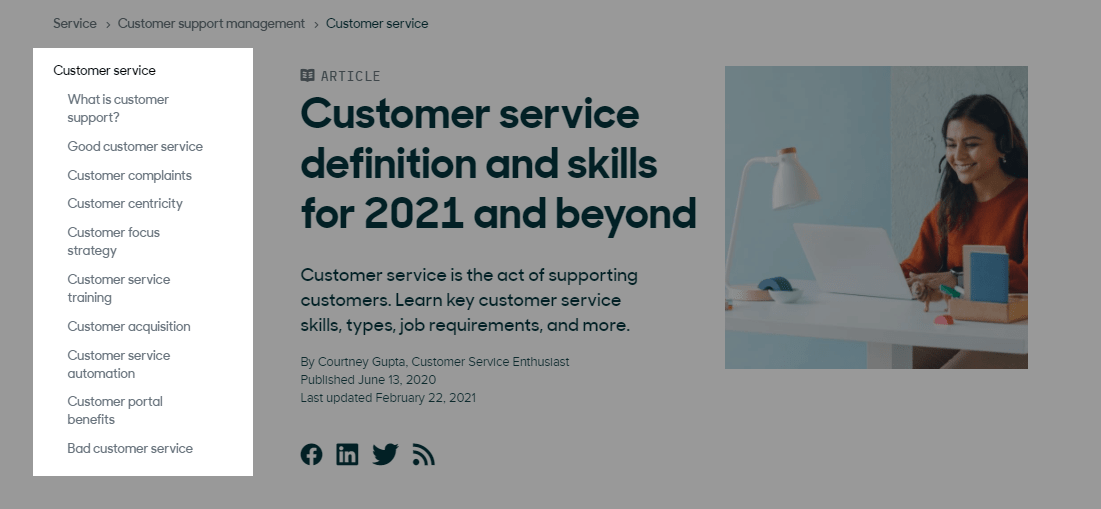
In the picture above, I’ve highlighted the hyperlinks on the Pillar page that lead to Supporting Articles. Each article also links back to the Pillar page, creating the Topic Cluster structure as we’ve seen at the beginning of this chapter.
If you have, like Zendesk, a lot of products you’ll have to create a lot of topic clusters. Here are all of Zendesk’s topic clusters, serving all possible audiences:
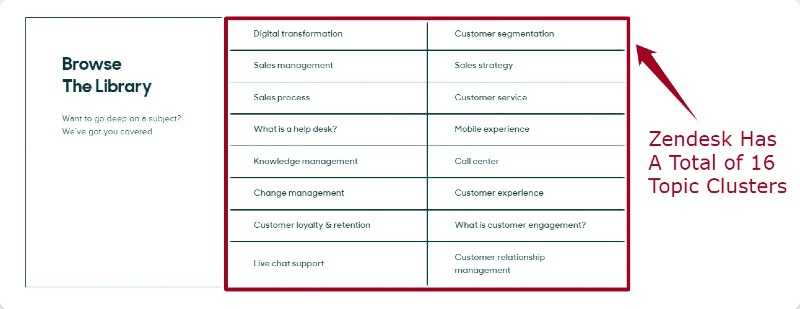
So, if you want to rank high and get quality traffic using Topic Clusters like Zendesk, you’ll have to stop thinking about which keywords you want to rank for and start thinking about which topics you want to own.
After you get a few clusters under your belt, your website will begin to look like this:
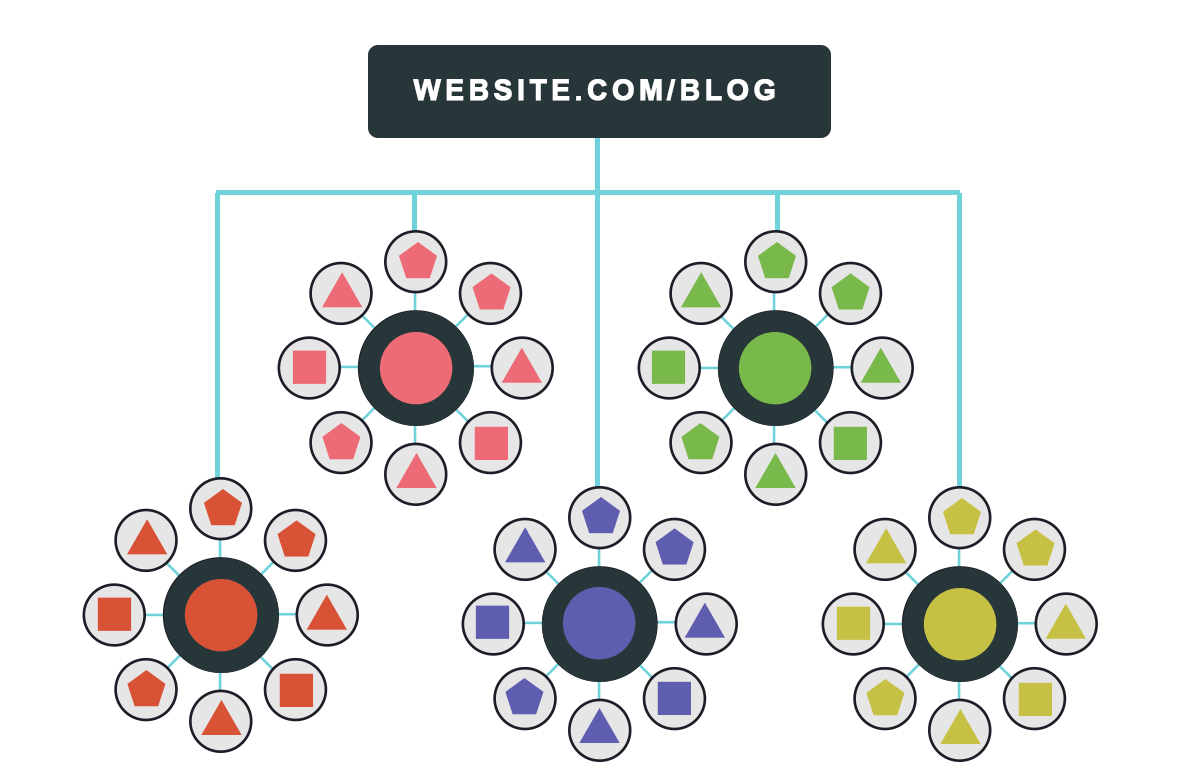
Remember, when you’re creating a topic cluster, you’re creating the best resource on the planet about a certain topic: something everyone will want to link to.
Meaning you can, regardless of your domain authority, rank unnaturally high for difficult keywords and steal rankings from your haphazzardly-blogging competition.
KEY TAKEAWAY: Topic Clusters are the best way to rank high for competitive keywords. First, identify the audience you want to attract. Then create the best resource on the planet about a topic that means a lot to your target audience. Write long-form content to stand out from the competition and entrench your rankings.
TIP #3:
Lead Generation Strategy
Create Online Tool That Surface Your Customer’s Problems Then Position Your Products As The Solution.
To generate new leads, a lot of SaaS companies create useful online tools like website graders, color pickers, or logo generators.
Zendesk decided to keep it simple. In 2015 and 2019, they created two simple tools called Zendesk Benchmark and Zendesk CX Trends.
Both of these tools show you how bad you are at CX — the only difference is that each presents the bad news from a different angle.
Together they form one of the weirdest lead generation funnels I’ve ever seen.
It starts with Zendesk Benchmark. Upon landing, you are encouraged to select your industry with a dynamic dropdown menu:
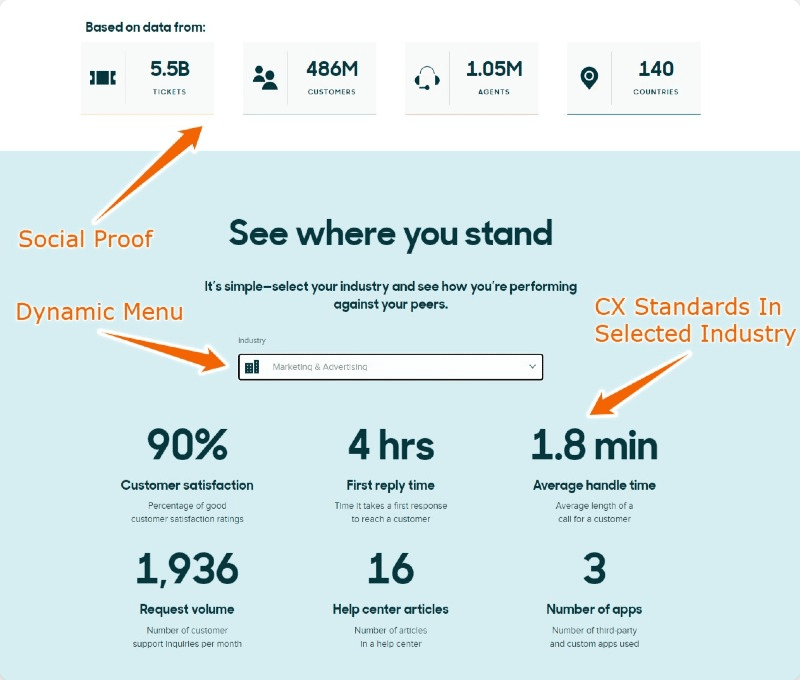
Immediately, Zendesk displays the standards in your industry for customer satisfaction, first reply time, and average handle time, and more.
If you have even the slightest idea about what’s going on in your customer experience department, these numbers raise an alarm: It’s very likely you’re underperforming in at least one of the six metrics.
Zendesk knows they likely surfaced a problem, that’s why they offer three solutions:
- They invite you to explore the customer experience trends more deeply with a CTA that leads to Zendesk CX Trends — their second marketing tool made to put you in their lead database. (We’ll return to this one in a moment.)
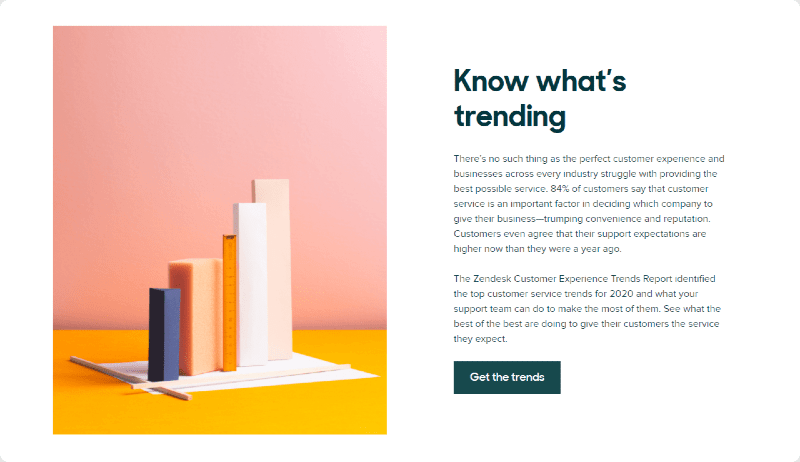
- An invitation to learn more about customer experience from their whitepapers and blog posts.
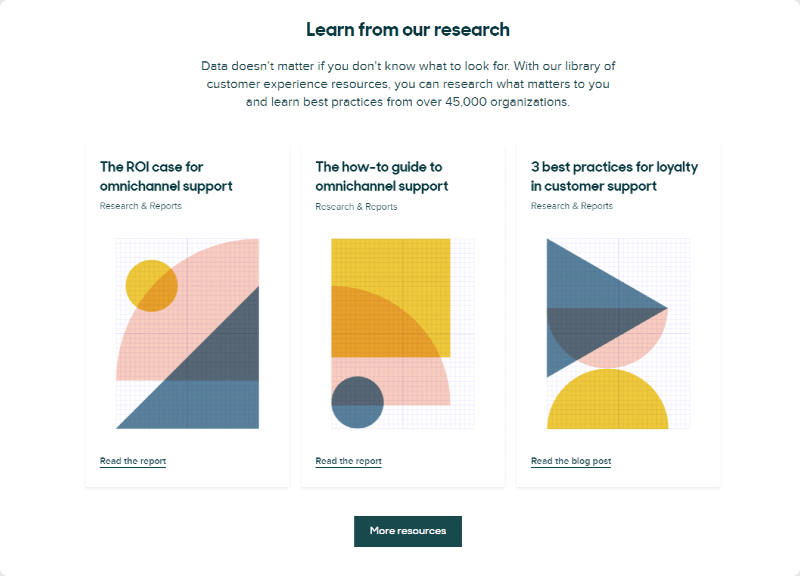
- And finally, a free trial button for everyone who’s been thinking about investing in Zendesk and this tool finally convinced them.
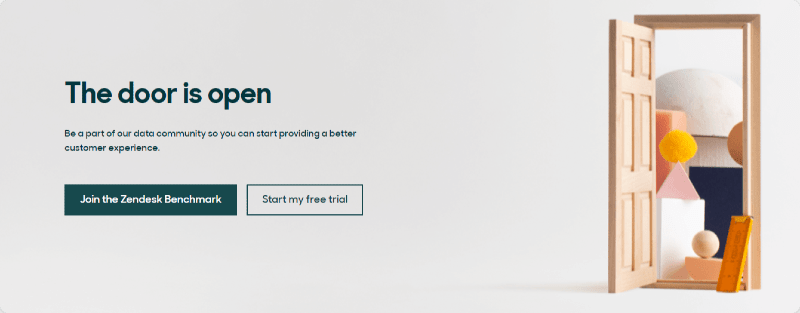
EMERGENCY DISCUSSION: Having multiple CTAs on a single page can create a lot of confusion. Do you want visitors to sign up or read more blogs? It seems odd at first, but Zendesk is using this page to redirect their large and diverse audience to proper pages.
Ultimately, Zendesk doesn’t care which CTA they choose, since Zendesk believes that the longer visitors stays on the site and the more pieces of content they consume, the closer they get to the sale.
For us, the first option is the most interesting.
Clicking on the button leads you to the CX trends page where you are immediately welcomed with a Customer Experience Performance Scorecard:
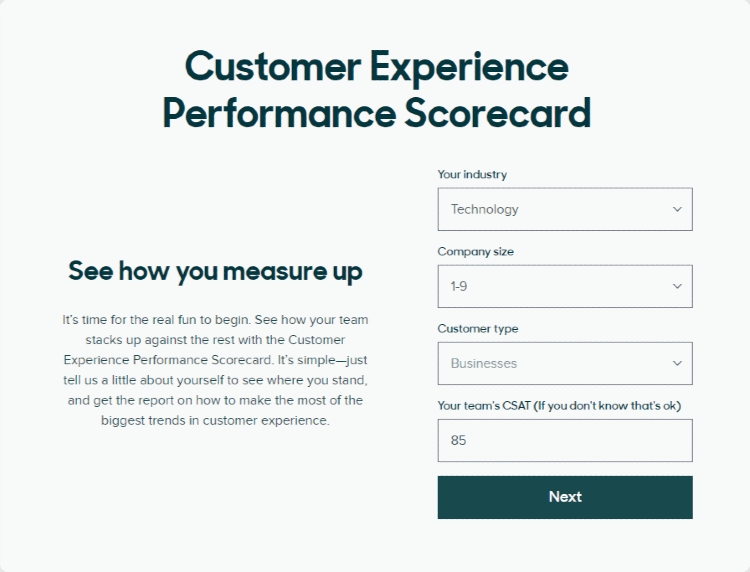
You are asked to enter your industry, company size, customer type, and customer satisfaction score (CSAT).
Clicking next displays additional fields which Zendesk uses to put you in their lead database — preparing the ground for a warm outreach from their sales team.
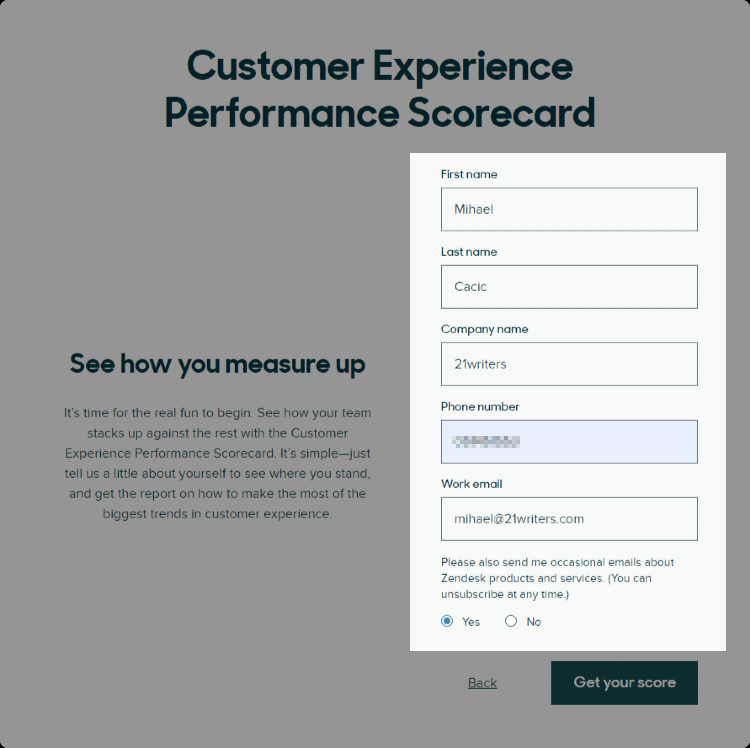
PRO TIP: These multi-step fill-in forms can work wonders for your conversions. Displaying only a handful of fields gets your visitors to commit more easily — and once committed, the chance of them filling out even more fields increases drastically.
After filling in the information, Zendesk shows you another benchmark. But this time, Zendesk gives you actual scores about how bad you suck:
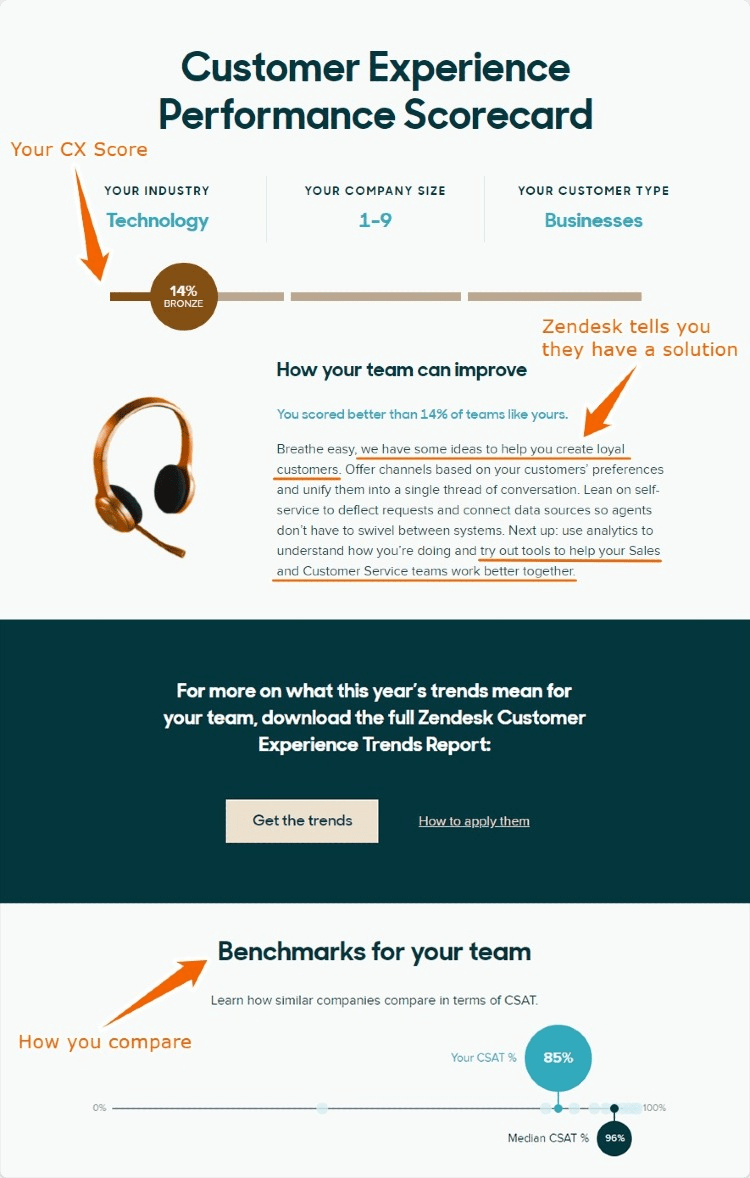
Here, Zendesk drills the fact that your customer support could use a facelift by comparing your CSAT scores with the CSAT scores of your competitors.
After that, the dark green section contains two options:
- Click on “Get the trends” and you’ll get Zendesk’s infamous 41-pages long yearly report on CX trends.
- Click on “How to apply [the trends]” and you’ll get a short case-study on a competitor from the industry you chose:
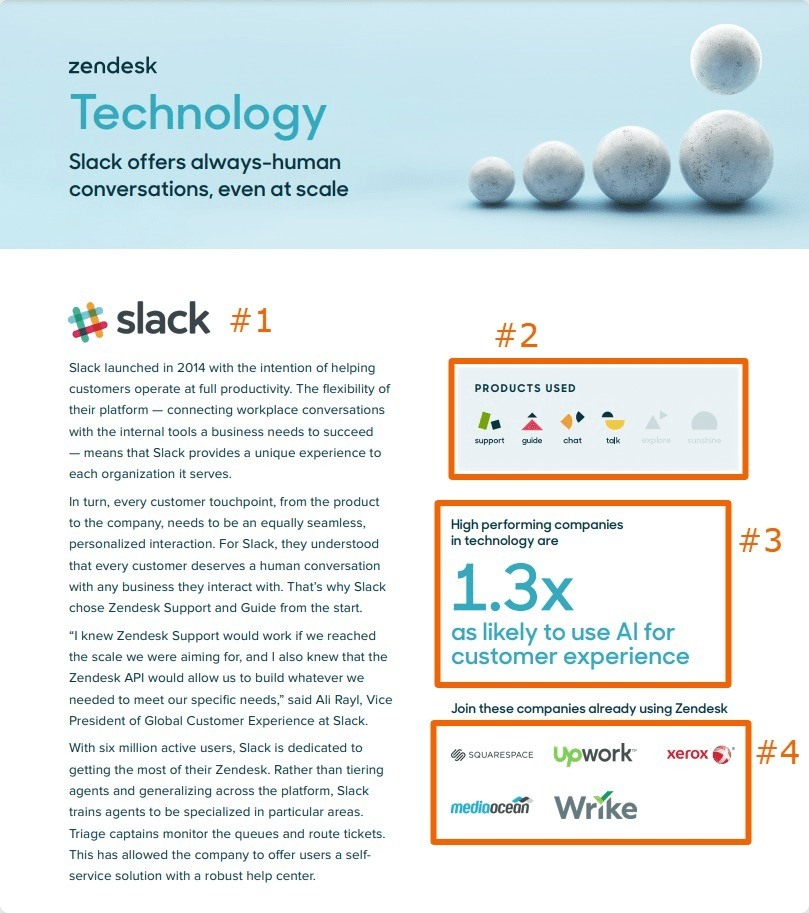
Here, Zendesk creates immense social proof by showcasing their biggest clients (#1, #4). They also show you which products these clients are using (#2): an attempt to induce fear of missing out and convince you that you also need these products to become a “high-performing” company (#3).
In case you didn’t click on any of the two buttons and scroll down, you are (again) met with product recommendations and some additional benchmarks similar to the ones at the start of this funnel.
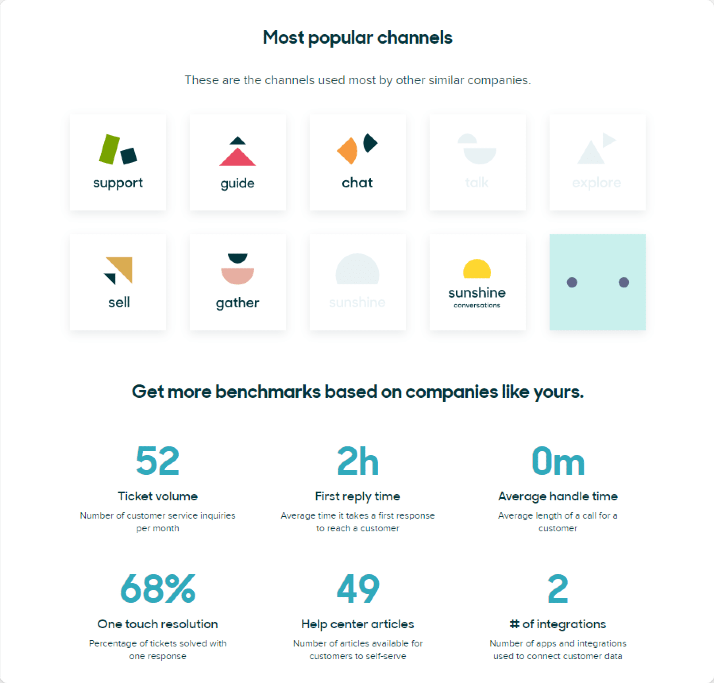

Overall, I think this sales funnel does a wonderful job at surfacing problems and positioning Zendesk as the solution. My only complaint is that it’s unusually long, slightly repetitive, and packed full of unrelated CTAs.
KEY TAKEAWAY: Build a simple tool that surfaces problems your customers are having. Immediately after, position your products as the solution. Include social proof from customer case studies to create massive FOMO and close the deal with a free trial.
TIP #4:
Sales Content Strategy
Get Existing Customers To Publicly Reveal Their Data And Help You Get More Leads By Inviting Them To Exclusive Groups And Stroking Their Ego With Epic Titles.
One of the best ways to convince potential customers to buy is by showing them how their colleagues got over a business hurdle using your product.
The content piece that explains this is known as a customer case study.
And Zendesk has over 244 case studies on companies like Riot Games, Vodafone, DollarShaveClub, Uber, and Airbnb, and more.
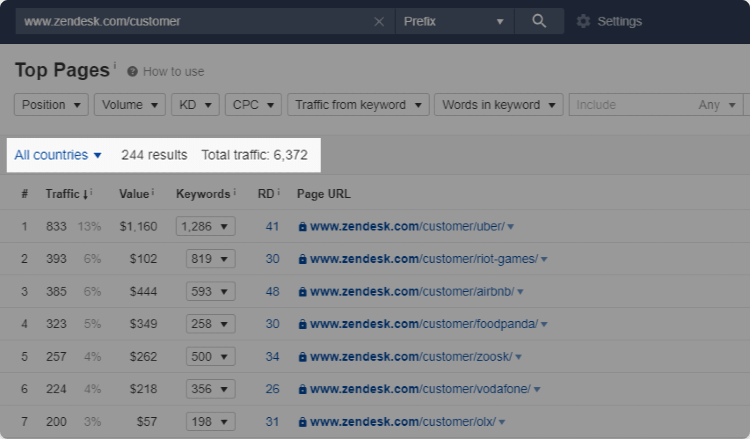
Besides using these case studies in their online tool as we’ve seen in tip #3, Zendesk uses these case studies to backup customer testimonials at two crucial points on their sales pages:
The first place is below the hero section…
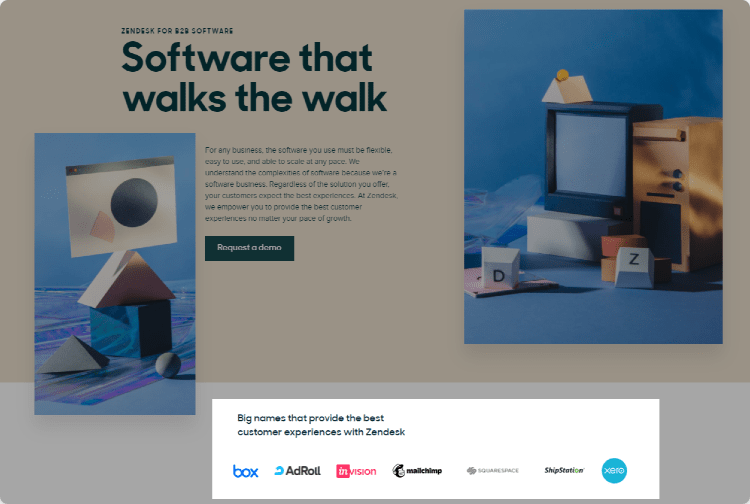
And the second place is below key action buttons…
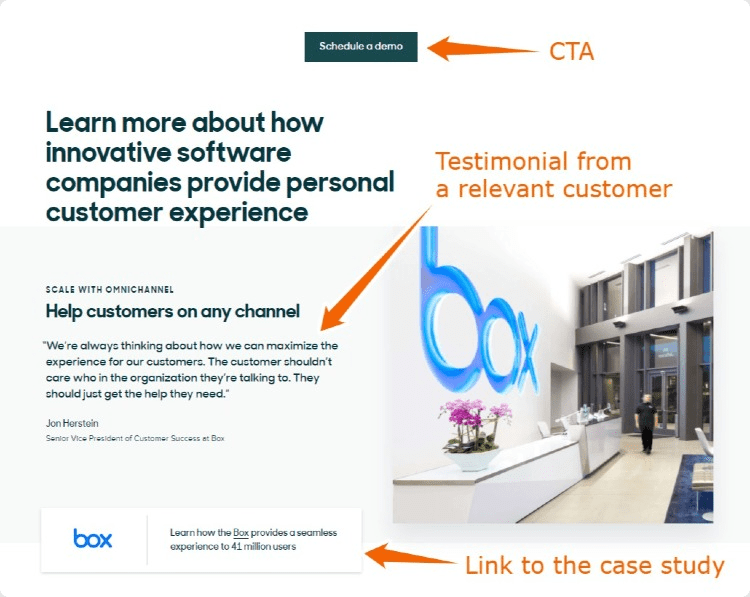
Having testimonials and customer brand logos on your sales page isn’t anything new. But I’ve never seen a company that invests this much effort into the legitimacy of their social proof — click on any testimonial or customer brand logo and it will take you to a unique case study.
The format of the case studies isn’t anything special. In fact, it’s quite standard:
- First, a summary explains who this case study is for and what kind of improvements they can expect.
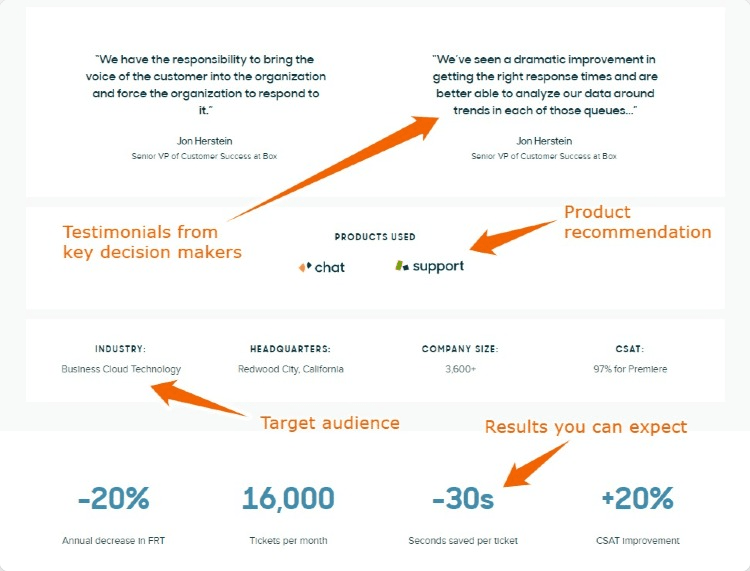
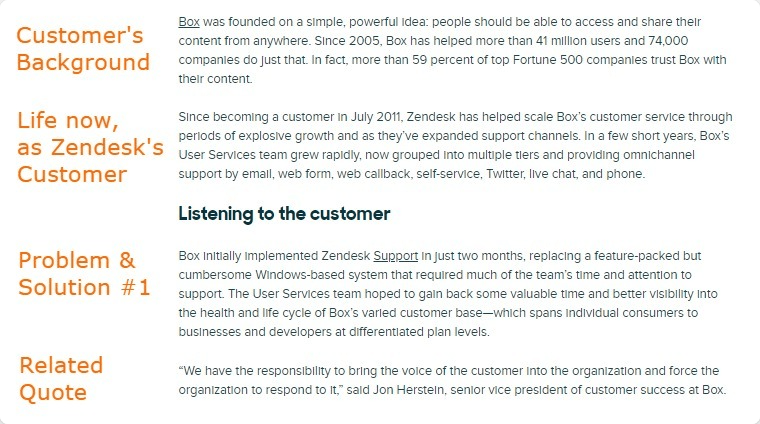
- Then, after a short introduction presenting the customer, Zendesk writes many problem-solution paragraphs backed by a ton of client quotes.
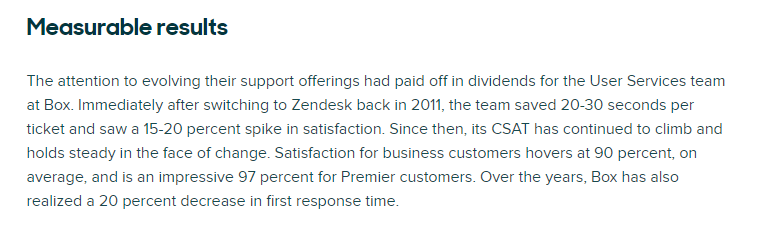
- Finally, after a few iterations of the above formula, Zendesk restated the results in the closing paragraph.
COMMENT: When it comes to case studies, I think Zendesk, like most companies, focuses too much on themselves. The best case studies aren’t sales pages — the best case studies are tutorials explaining exactly how to solve a problem using the client as an example (like what I’m doing with this case study).
Remember, readers doesn’t care about you or your clients: they only care about themselves and their problems.
PRO TIP: If you want to write case studies like Zendesk, you can browse and analyze all of Zendesk’s case studies here.
That said, these case studies still help Zendesk defuse objections and instill trust in potential customers.
Although the quality of the case studies isn’t that interesting, the amount of them is: how does Zendesk get its biggest clients to publicly reveal their data? And to reveal enough of it for a 2000 word report? And how did Zendesk manage to do this over 200 times?
It turns out Zendesk farms case studies in their Customer Community Program called Luminaries — an exclusive group for Zendesk customers where they get free training, invitations to exclusive events, early access to products, and a chance to network with other Luminaries.
Epic!!! Every SaaS founder who wants to grow ARR up and to the right needs to read this.
Thank you, Chris!
You really make it seem so easy with your presentation but I find this matter to be really something that I think I would never understand.
It seems too complicated and extremely broad
for me. I am looking forward for your next post, I will try to get
the hang of it!