



Self-paced online courses have a completion problem. Industry data shows that only 5-15% of students who enroll in a self-paced course finish it. The content might be good, but without structured timelines, peer accountability, and live interaction, most learners disengage after the first few modules.
Cohort-based courses flip that dynamic.
By grouping students on a shared schedule, adding live sessions, and building in peer interaction, cohort programs achieve completion rates of 85-95%. The trade-off is operational complexity: facilitators need infrastructure for live sessions, community spaces, assignment management, and synchronized content delivery that self-paced platforms were never designed to handle.
That’s where cohort-based course platforms come in.
We researched and tested the leading platforms in this space and shortlisted the best options for key use cases:
- Running your entire expert business (courses, coaching, community, marketing) from one platform,
- Using AI to build and scale cohort programs without scaling headcount proportionally,
- Building community-first learning where peer engagement drives completion,
- Launching affordable cohort programs without enterprise complexity,
- Testing a cohort concept with zero upfront platform cost,
- Structuring programs around peer review and collaborative assessment,
- And converting course buyers into long-term community members.
Let’s look at a quick summary of these platforms.
What Are Cohort-Based Course Platforms?
Cohort-based course platforms are software tools that let educators, coaches, and training organizations deliver structured learning programs where a group of students moves through the curriculum together on a shared timeline. Unlike self-paced course hosts that let students start and finish whenever they choose, cohort platforms provide the scheduling, live session infrastructure, community tools, and progress tracking needed to run time-bound programs with real-time interaction and peer accountability.
These platforms typically include live video integration, discussion spaces, assignment submission workflows, automated reminders, and enrollment management, all built around the principle that learning works better (and gets completed more often) when it happens in a group.





How To Choose The Best Cohort-Based Course Platform
Here’s a short checklist to help you find the right platform for your cohort program:
- Live Session Infrastructure: Your platform should make it easy to schedule, deliver, and record live sessions without requiring separate video conferencing subscriptions or manual coordination.
- Community and Peer Interaction: Cohort programs thrive on accountability. Look for native discussion spaces, direct messaging, and engagement features that keep students connected between live calls.
- Scheduling and Automation: Running a cohort involves dozens of operational tasks (reminders, drip content, enrollment management). The right platform automates these so facilitators can focus on teaching.
- Scalability: Can you run multiple concurrent cohorts, accommodate growing enrollment, and maintain facilitation quality without scaling your team at the same rate?
- Monetization Flexibility: Your platform should support one-time purchases, payment plans, subscriptions, and bundled offers so you can price cohort programs to match your audience’s buying preferences.
- Total Cost of Ownership: Look beyond the subscription price. Consider transaction fees, the cost of separate tools you’d need to stitch together, and whether the platform replaces multiple subscriptions or adds to your tech stack.
How We Picked The Platforms
We started by identifying the most-discussed cohort-based learning platforms across educator communities, review sites, and professional training networks. We then evaluated each platform against the criteria above, tested their cohort-specific features (live sessions, community, scheduling, content delivery), and assessed how well each handles the operational realities of running time-bound group programs.
We focused on platforms that differentiate for cohort delivery, not self-paced course hosts with a calendar feature bolted on. Each platform earned its spot by excelling at a specific use case within cohort-based learning.
1. Kajabi — Best All-in-One Platform for Experts Building a Cohort Course Business
Most cohort-based course platforms solve one piece of the puzzle: they host your course, maybe add a community space, and leave you to figure out the rest. You still need an email marketing tool, a website builder, a payment processor, a coaching scheduler, and a sales funnel system, all from different providers, all requiring separate logins, integrations, and monthly fees.
Kajabi takes a different approach.
Kajabi is an all-in-one platform built for experts who want to run their entire knowledge business, including cohort-based courses, from a single system. Its cohort-based course format includes native live video session scheduling, built-in community with gamification, email marketing automation, sales funnels, and zero transaction fees on all plans, so experts can focus on teaching instead of managing a scattered tech stack.
|
Kajabi Pros |
Kajabi Cons |
|---|---|
|
✅ Courses, coaching, community, email, website, and payments in one platform |
❌ Higher starting price than single-purpose platforms |
|
✅ Zero transaction fees on all paid plans |
❌ Contact limits may require plan upgrades as your list grows |
|
✅ Native cohort course format with live video scheduling |
❌ Page builder less flexible than dedicated landing page tools |
|
✅ AI business partner (Cofounder) included at no extra cost |
❌ Community features still maturing relative to dedicated community platforms |
|
✅ Branded mobile app on Pro plan |
Why Choose Kajabi for Cohort-Based Courses?
Over 100,000 businesses have been built on Kajabi, with experts collectively earning $10 billion+ on the platform. Top institutions and individual experts, including Justin Welsh (who has earned $10M+ on the platform), rely on Kajabi to run their knowledge businesses.
⭐ If you’ve been thinking about starting your online business, this is your sign. Get 30 days of Kajabi free instead of the usual 14 days when you use this special link — no pressure, no rush, just more time to grow.
Cohort Course Delivery: Run structured programs with live sessions and drip scheduling
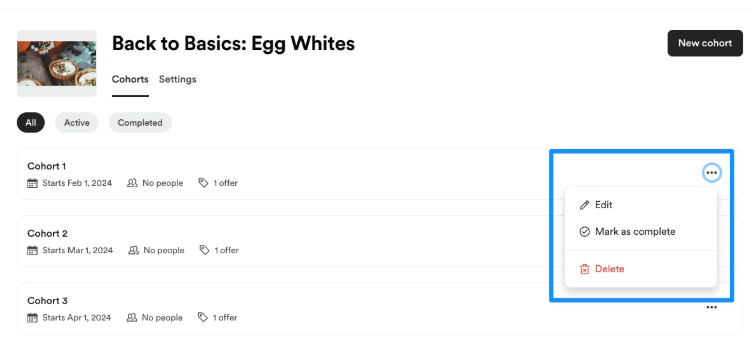
Kajabi’s cohort-based course format pairs structured content delivery with scheduled live video sessions. Facilitators organize curriculum into modules and lessons with drip scheduling that releases content at set intervals, and content locking prevents students from skipping ahead.
Source: Kajabi
Live sessions are scheduled directly within the course using Kajabi’s built-in live video, which supports breakout rooms, auto-recording, and screenshare. Facilitators who prefer external tools can integrate Zoom and Google Meet natively.
The AI Course Generator builds full module-and-lesson outlines from a plain-text prompt, reducing the blank-page problem when designing a new cohort curriculum. And transcriptions, translations, and dubbed voiceovers in 70+ languages let facilitators serve global cohorts without re-recording content.
Community and Coaching: Build accountability beyond the course content
Kajabi’s Community product lives inside the same platform as your courses, so cohort members can join discussions, attend Live Rooms (with breakout groups and recording), participate in Challenges, and track progress on leaderboards with a customizable gamification system.
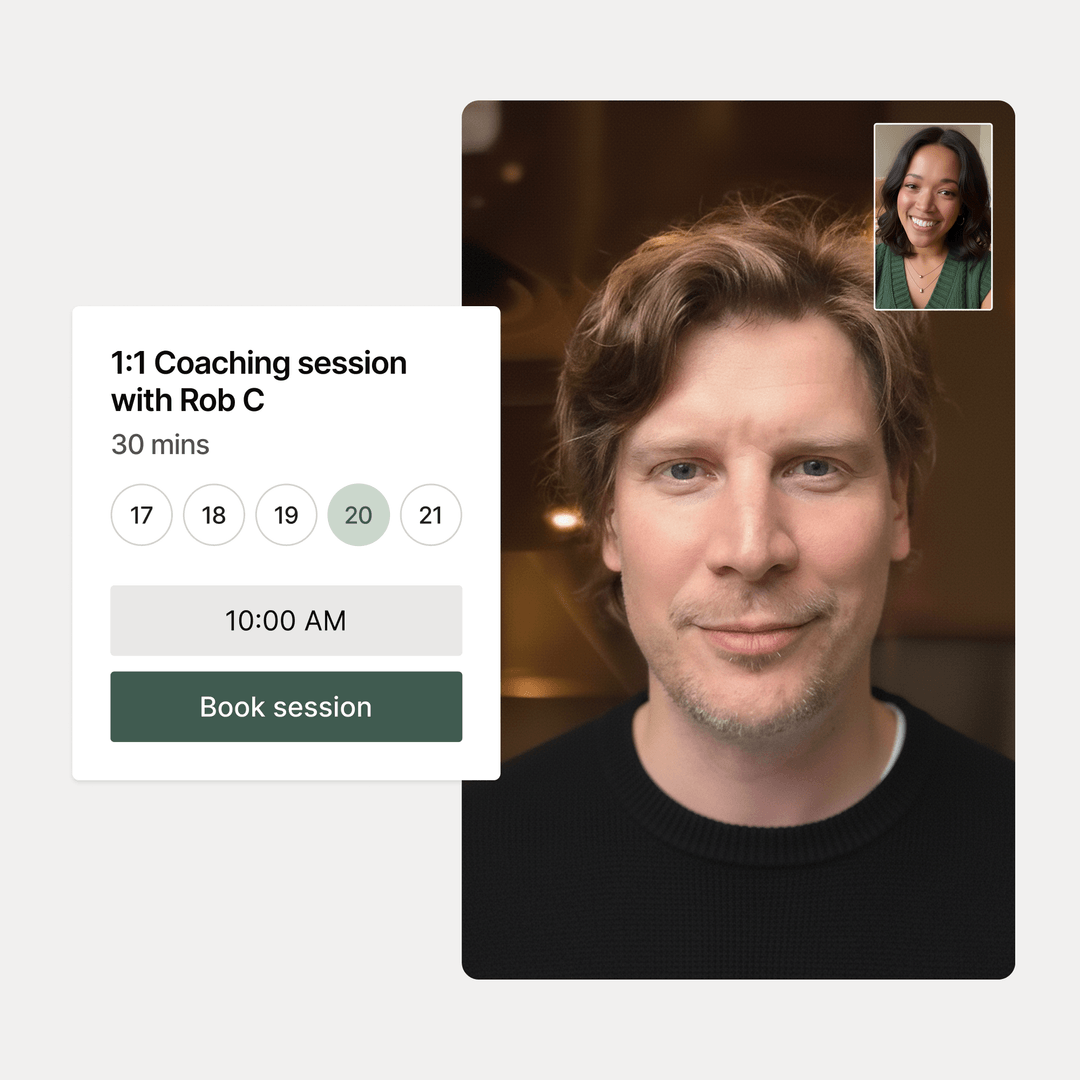
For programs that include 1:1 or group coaching, Kajabi’s native Coaching product adds scheduling, session notes, and client management without a separate tool. This makes Kajabi a strong fit for experts running hybrid programs (cohort course plus coaching), a model that commands premium pricing.
Source: Kajabi
Marketing and Sales: Fill your cohorts without stitching tools together
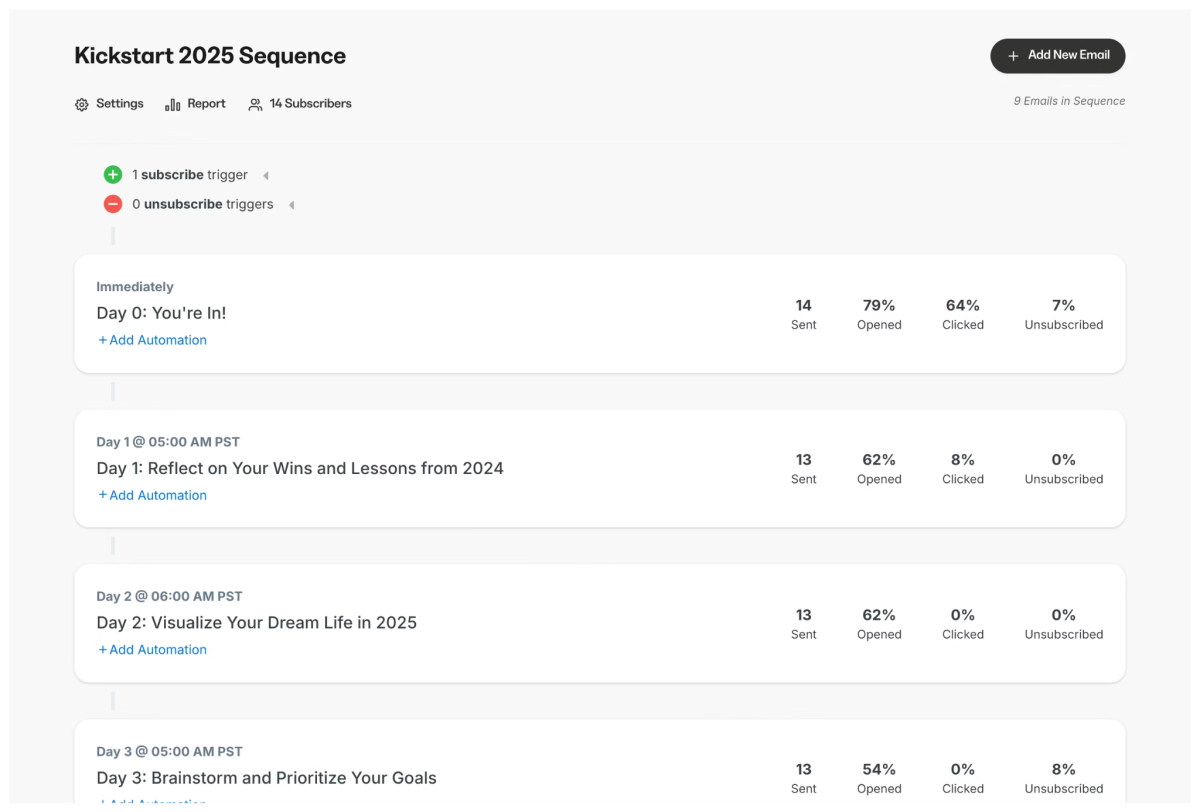
Most cohort platforms leave marketing entirely to you. Kajabi includes email campaigns and sequences, funnels (with pre-built webinar registration and product launch templates), behavioral automations, and a complete sales and checkout system with order bumps, payment plans, and 140+ currency support.
This consolidation matters for cohort businesses because filling a cohort is a time-sensitive marketing problem: you need to drive enrollment by a specific date, nurture a waitlist between launches, and convert attendees from free workshops into paid cohort students. Kajabi handles that entire funnel natively.
Source: Kajabi
Kajabi Pricing
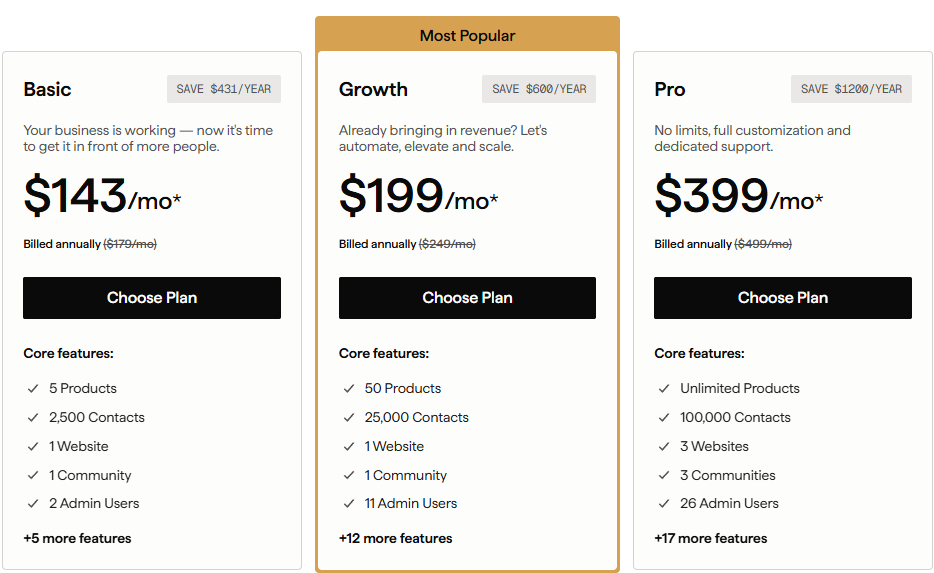
Kajabi uses a flat-fee subscription model with no transaction fees on any paid plan:
- Basic Plan ($143/month annual, $179/month monthly). 5 products, 2,500 contacts, 1 community.
- Growth Plan ($199/month annual, $249/month monthly). 50 products, 25,000 contacts, 1 community, 11 admin users.
- Pro Plan ($399/month annual, $499/month monthly). Unlimited products, 100,000 contacts, 3 communities, branded mobile app, API access.
A free trial is available. All plans include unlimited marketing emails, landing pages, and funnels.
Source: Kajabi
Use Kajabi if:
- You want to run your entire expert business (cohort courses, coaching, community, email marketing, website, and payments) from one platform without managing multiple subscriptions
- You’re building a multi-product business where cohort courses are one offering alongside coaching programs, memberships, and digital downloads
- You need marketing infrastructure (funnels, email sequences, automations) to fill your cohorts and don’t want to pay for a separate email tool
“I moved over to Kajabi and had all that stuff under one roof, which was a blessing for my business.” (Justin Welsh)
⭐ Don’t rush your setup in just 14 days. Get a full 30 days free with Kajabi using this exclusive link and experience everything you need to create, market, and sell your offers online.
2. Thinkific — Best for Affordable Cohort Courses Without Enterprise Complexity
Thinkific gives creators the core infrastructure to launch cohort-based learning programs without a large upfront budget or technical expertise.
The platform combines unlimited live lessons through native Zoom integration, structured assignments for accountability, private community spaces for cohort collaboration, and flexible membership packaging, all starting at $40/month on annual billing with zero platform transaction fees.
|
Thinkific Pros |
Thinkific Cons |
|---|---|
|
✅ 0% platform transaction fees on all plans |
❌ Live lessons and assignments not available on Basic plan |
|
✅ Unlimited live Zoom lessons on Start plan and above |
❌ Community features lighter than dedicated community platforms |
|
✅ Structured assignments with manual instructor review |
❌ No built-in email marketing or sales funnels |
|
✅ 30-day free trial on every plan |
❌ No free plan; Basic caps at 10,000 students |
Thinkific: Top Features for Cohort Learning
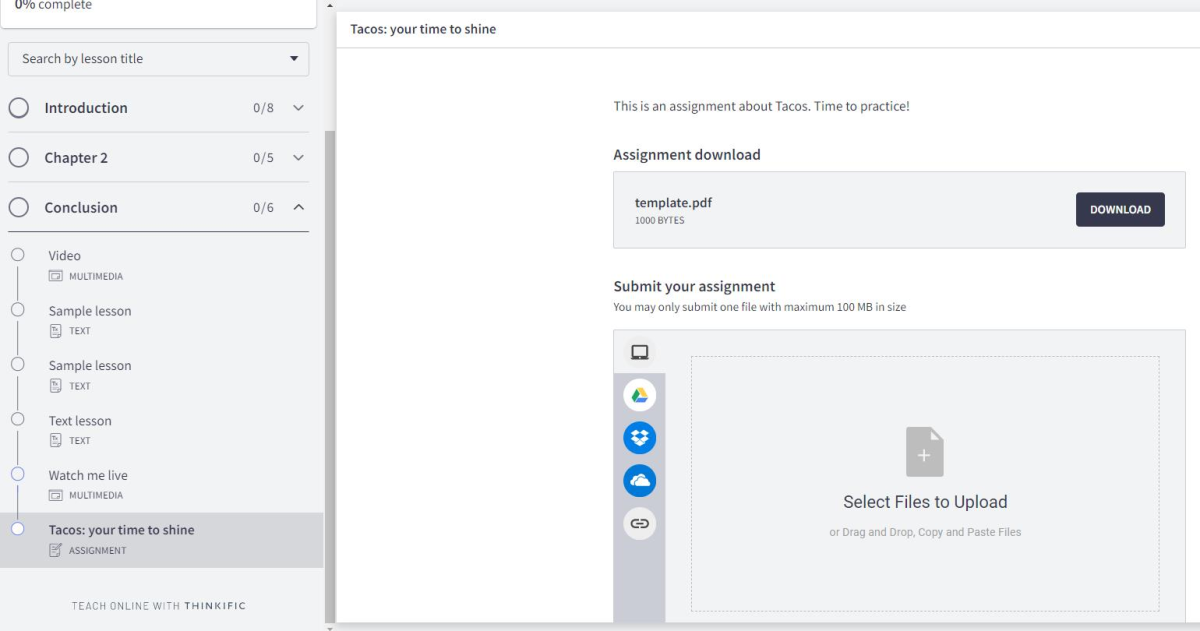
Thinkific’s Start plan and above include unlimited live lessons powered by native Zoom integration. Creators configure live lessons directly within the course builder, and students see upcoming sessions with one-click join links, automated reminders, and attendance logging.
The Assignments lesson type requires students to submit work for instructor review before moving to the next module, creating the accountability checkpoints that cohort programs need. Instructors review submissions, provide written feedback, and approve or request revisions from a centralized dashboard.
Source: Thinkific
Community Spaces offer private, branded discussion areas organized into topic-specific spaces (for example, a “Cohort 5 Discussion” space and a “Wins & Celebrations” space). The 2025 updates added Direct Messaging, Weekly Digest Emails, and video upload support.
Thinkific Pricing
All plans include 0% platform transaction fees (standard processing fees of 2.9% apply separately). A 30-day free trial is available on every plan — Thinkific no longer offers a permanent free tier.
- Basic ($40/month annual, $54/month monthly). Unlimited courses, 10,000 students, 1 community with 5 spaces. No live lessons or assignments.
- Start ($82/month annual, $109/month monthly). Unlimited live Zoom lessons, assignments, certificates, memberships, 1 community with 10 spaces.
- Grow ($164/month annual, $219/month monthly). 3 communities with 20 spaces each, white-label branding, API access, priority support.
- Plus (custom pricing). Multi-tenant environments, SCORM compliance, SSO, Thinker AI assistant, branded mobile app on select tiers.
Use Thinkific if:
- You’re launching your first cohort program and need proven infrastructure (live lessons, assignments, community) without committing to $200+/month platforms
- You want to keep platform costs low and reinvest revenue into content production or paid marketing
- Your cohort model prioritizes live instruction and accountability over advanced marketing automation
⭐ If you’ve been sitting on a course idea, this is your sign. Try Thinkific free for a full 30 days through this link — build the courses, host the community, test the AI tools, and cancel any time before you pay a cent.
3. Disco — Best for AI-Powered Social Learning Programs at Scale
Disco is an AI-native social learning platform designed to turn organizational expertise into cohort-based programs in hours rather than weeks.
Where most platforms offer AI as a content generation add-on, Disco was built with AI at the core, using a four-agent system (Design Agent, Learner Agent, Community Agent, and Operations Agent) that handles curriculum generation, learner support, engagement automation, and operational tasks.
|
Disco Pros |
Disco Cons |
|---|---|
|
✅ AI Design Agent generates full curricula from existing materials |
❌ $399/month starting price limits accessibility |
|
✅ Ask AI provides 24/7 learner support from your own content |
❌ 500-member cap on Organization plan |
|
✅ Social learning drives 85-90% completion rates |
❌ Enterprise features require custom pricing |
|
✅ Integrated cohort scheduling, community, and live events |
Disco: Top Features for Cohort Learning
Disco’s Design Agent ingests existing documents, slide decks, or recorded webinars and generates complete curricula with modules, lessons, quizzes, and discussion prompts. Coding Temple cut their program development timeline from six months to two months using this feature.
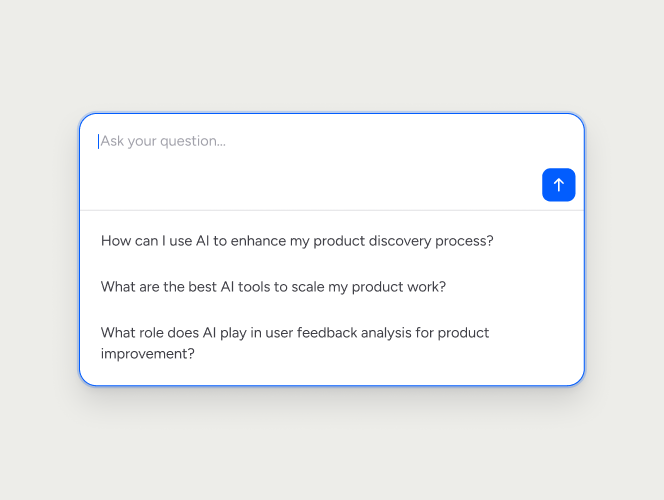
The Ask AI feature draws from an organization’s own content library to answer learner questions instantly, reducing instructor Q&A load. D2D Experts reported a 75% reduction in learner Q&A time after deployment.
Source: Disco
Social learning features (channel discussions, live events, direct messaging, gamified leaderboards) are native to every program. Kids & Company achieved an 85% course completion rate, and Ten More In reported 90%, compared to the 15-20% industry average for self-paced courses.
Disco Pricing
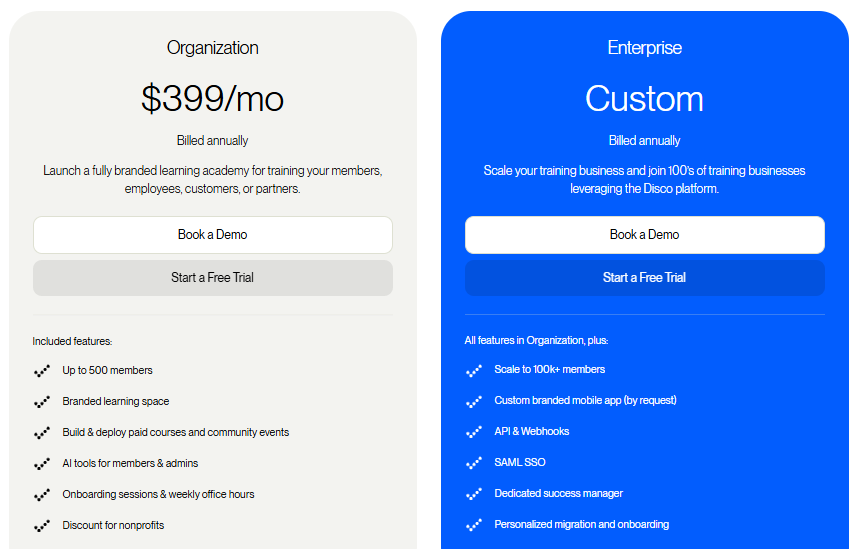
- Organization Plan ($399/month annual, $499/month monthly). Up to 500 members, unlimited learning products, all AI tools, branded learning space, mobile app. 14-day free trial available.
- Enterprise Plan (custom pricing). Scales to 100,000+ members, custom-branded mobile app, API/Webhooks, SAML SSO, dedicated success manager.
Source: Disco
Use Disco if:
- You’re running multiple cohort programs at once and need AI to compress curriculum development from months to weeks
- Completion rates directly determine your program’s ROI (bootcamps, certification programs, customer education academies)
- You need to scale learner support without hiring proportionally more instructors
4. Mighty Networks — Best for Community-First Cohort Courses with Mobile Engagement
Mighty Networks is a community-first platform that layers structured courses directly into social spaces.
Unlike platforms that bolt community features onto a course player, Mighty Networks builds courses inside the same Feed, Chat, Events, and Member directory where peer connection happens naturally. The platform reports that 84% of activity is member-led (peer-to-peer interaction), and 59% of active members return weekly.
|
Mighty Networks Pros |
Mighty Networks Cons |
|---|---|
|
✅ Community and courses structurally integrated, not separate |
❌ Transaction fees (0.5-2%) on all plans |
|
✅ Native iOS/Android app drives 60% more activity than web |
❌ Custom branded app requires Mighty Pro ($17K+/year) |
|
✅ Native livestreaming up to 1080p HD with recurring events |
❌ Less sophisticated marketing automation than all-in-one platforms |
|
✅ Gamification with streaks, recognitions, and leaderboards |
Mighty Networks: Top Features for Cohort Learning
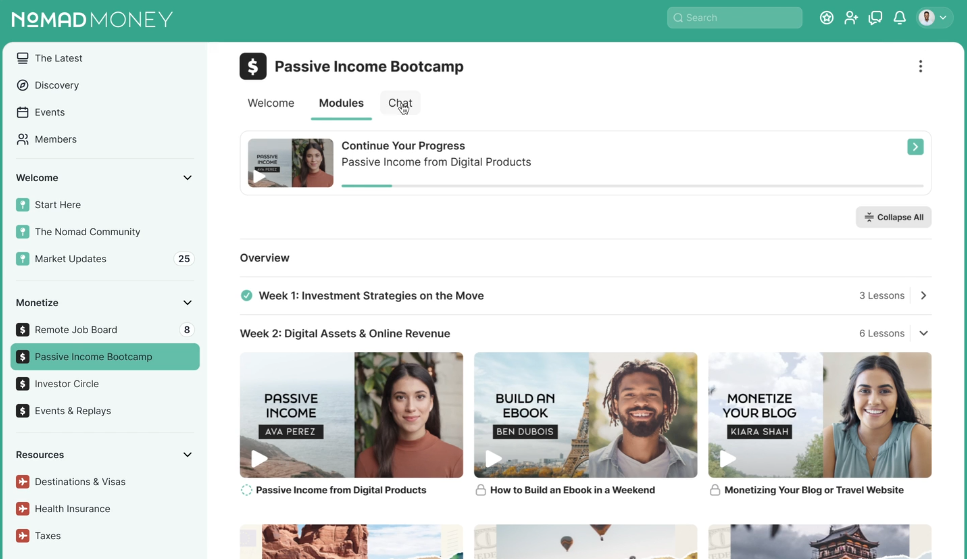
Mighty’s Cohort Course Template includes a Feed, Course materials, Events, and a Members directory inside the same Space. When a cohort member opens a lesson, they see who else is working on it and the ongoing discussion, all in one interface.
Source: Mighty Networks
Events can recur on daily, weekly, or custom intervals with native livestreaming (up to 1080p HD with live chat, emoji reactions, and multi-speaker support), automatic timezone localization for global cohorts, and automated RSVP reminders. This eliminates the need for separate Zoom, Calendly, and Eventbrite subscriptions.
Gamification tracks engagement automatically: Streaks measure consecutive active days, Recognitions let members award each other points based on community-defined values, and Leaderboards rank members by peer recognition received.
Facilitators get a Progress Tracking dashboard showing each member’s completion percentage and can trigger automated re-engagement messages when members go inactive.
Mighty Networks Pricing
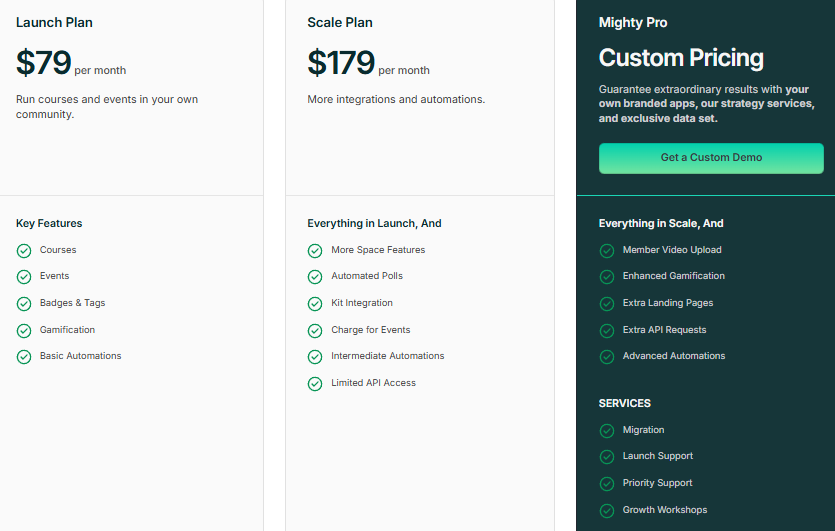
- Launch ($79/month). Courses, events, gamification, basic automations, 20 livestreaming hours/month. 2% transaction fee.
- Scale ($179/month). Intermediate automations, ConvertKit integration, charge for individual events. 1% transaction fee.
- Growth ($354/month). Advanced automations, expanded API, migration support. 0.5% transaction fee.
- Mighty Pro (custom pricing, ~$17,000/year). Custom-branded iOS/Android apps, dedicated strategy teams.
Source: Mighty Networks
Use Mighty Networks if:
- Your cohort program depends on peer accountability and member-to-member interaction as a core part of the learning model
- You want to run live sessions, recurring workshops, and events without separate video conferencing tools
- Mobile engagement matters: you need cohort members actively participating between live sessions from their phones
⭐ Build a thriving community with Mighty Networks using this exclusive link. Create memberships, courses, events, and meaningful member experiences all in one place.
5. Maven — Best Marketplace Platform for Teaching Cohort Courses With No Upfront Cost
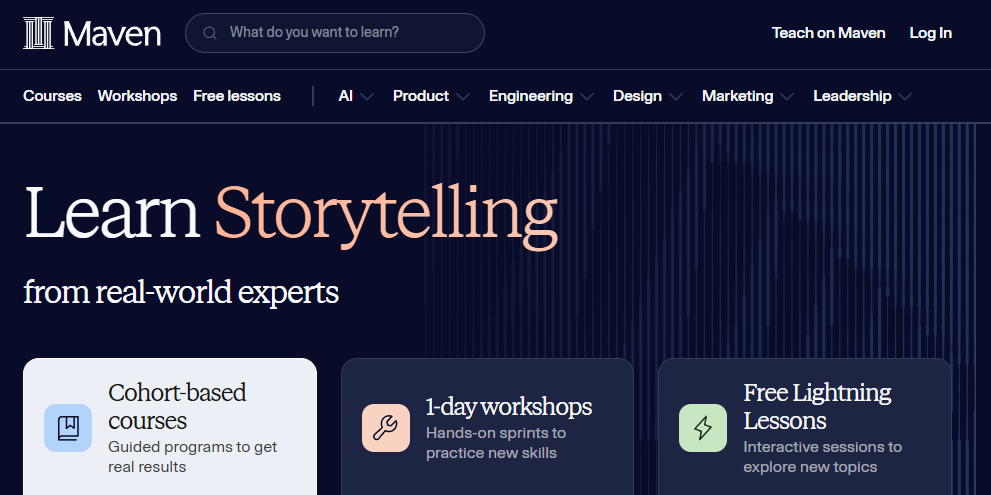
Maven eliminates the financial risk of launching a cohort course by charging no upfront fees, instead taking 10% of revenue per paid student while instructors keep 90%.
The platform connects working practitioners with a marketplace of 500,000+ learners browsing for professional development, solving both the financial risk problem and the audience cold-start problem at once.
|
Maven Pros |
Maven Cons |
|---|---|
|
✅ Zero upfront cost; pay only when students pay you |
❌ 10% platform fee on every enrollment |
|
✅ Built-in marketplace with 500K+ active learners |
❌ Courses not visible in marketplace search until minimum enrollment threshold |
|
✅ Lightning Lessons for free lead generation |
❌ No white-label branding (Maven’s brand is visible) |
|
✅ Average instructor earns $10,000 in Year 1 |
❌ Minimum course price of $200 |
Maven: Top Features for Cohort Learning
Maven’s zero-risk model lets instructors build a full course landing page, set up a multi-week syllabus with live sessions and assignments, configure automated email sequences, and launch, all without paying a dollar upfront. The platform only earns when the instructor earns.
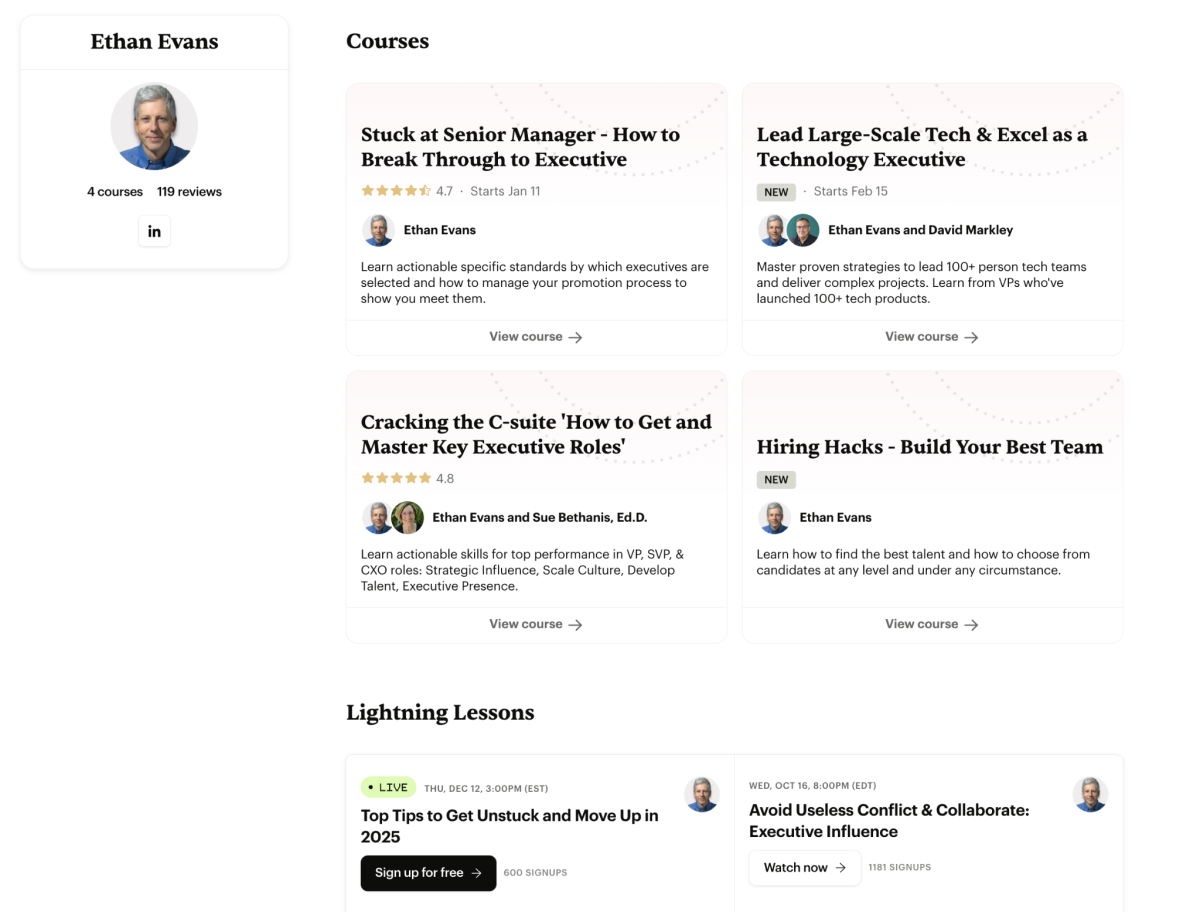
The built-in marketplace provides distribution that standalone platforms cannot match. When you publish a course, it appears in relevant category pages and can be included in Maven’s weekly newsletter to hundreds of thousands of subscribers. The average Maven instructor earns $10,000 in Year 1, and top courses have earned over $100,000 in the platform’s first months.
Lightning Lessons are free, 30-minute live teaching sessions that work as a lead generation engine. Every signup is automatically added to the instructor’s waitlist. Students who attend 5+ Lightning Lessons are 15x more likely to purchase a full course, and over 500 Lightning Lessons have reached 100,000+ students to date.
Source: Maven
Maven Pricing
- Free to use until a student pays. No monthly subscription, setup fee, or listing fee.
- Instructors keep 90% of all course revenue; Maven takes a flat 10% platform fee per paid enrollment.
- Stripe processing fees (approximately 2.9% + $0.30) apply separately.
- Student Growth Program allows Maven to offer promotional discounts (up to 30%), affiliate fees (up to 30%), and B2B partner fees (up to 40%) on certain sales, which reduce the instructor’s net share on affected transactions.
Use Maven if:
- You want to test demand for a cohort course concept without financial risk before committing to a monthly platform subscription
- You’re a working practitioner with subject-matter expertise but no large existing audience, and need marketplace distribution to fill your first cohort
- You value the credibility of a curated platform associated with recognized industry practitioners over white-label branding
6. Teachfloor — Best for Peer Review and Collaborative Group Assessment
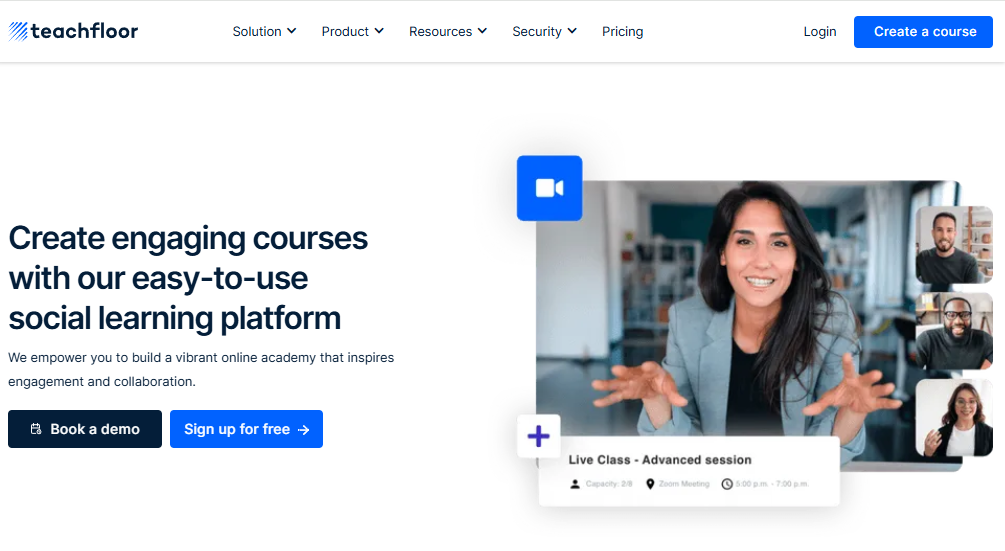
Teachfloor is a social learning platform built around collaborative, cohort-based learning.
Where most platforms treat peer interaction as optional discussion boards, Teachfloor embeds peer review, group assessment, and collaborative accountability directly into the curriculum structure, making it the strongest option for programs where learners evaluating each other’s work is a pedagogical requirement.
|
Teachfloor Pros |
Teachfloor Cons |
|---|---|
|
✅ Most comprehensive peer review and group assessment tools in the category |
❌ Detailed pricing not published publicly beyond starting price |
|
✅ AI Review scales instructor feedback without sacrificing quality |
❌ White-label features only on higher plans |
|
✅ Native Zoom sync with automatic recording upload and attendance tracking |
❌ Best features require structured program design |
|
✅ 0% platform transaction fees |
Teachfloor: Top Features for Cohort Learning
Teachfloor’s peer learning layer supports a complete workflow: learners submit work via a Submission element, which feeds into a Peer Review element with instructor-configured rubrics (open-ended, numeric rating, text scale, yes/no). After receiving peer feedback, learners process insights through a Feedback Reflection element.
For group-based work, Group Formation, Group Submission, Group Review, and Group Feedback Reflection elements create end-to-end collaborative assessment chains.
Pre-built Sequences auto-configure entire assessment workflows in a single click, reducing setup complexity. The University of Padova uses Teachfloor for peer review in teacher education programs.
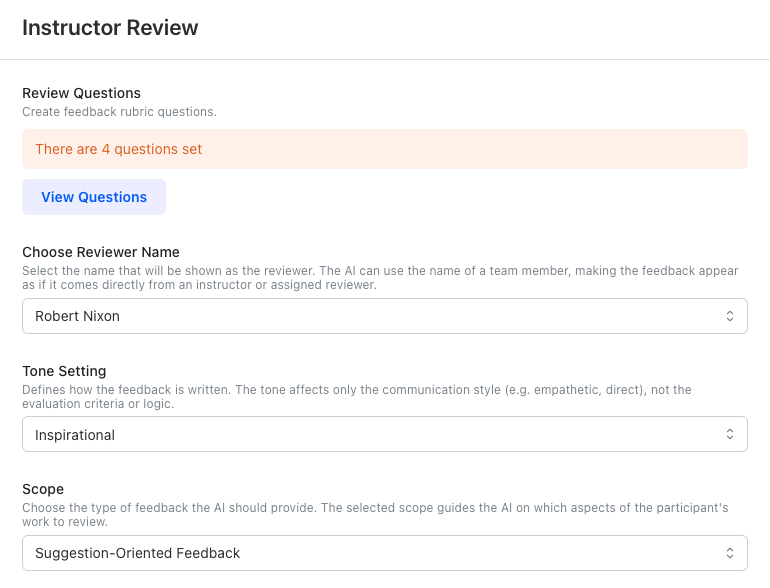
AI Review evaluates learner submissions against instructor-defined rubrics automatically, with configurable feedback tone (Inspirational, Supportive, Neutral, Critical, Educational, Friendly) and scope (Suggestion-Oriented, Error Detection, Evaluation/Grading). This is designed for universities, bootcamps, and corporate training where instructors need to maintain quality across hundreds of submissions.
Source: Teachfloor
Native Zoom integration automatically syncs attendance tracking, uploads recordings, and sends calendar invitations. Ludi (Turkey), which trains 100,000+ learners, chose Teachfloor over Thinkific and Teachable for its collaborative and cohort management features.
Teachfloor Pricing
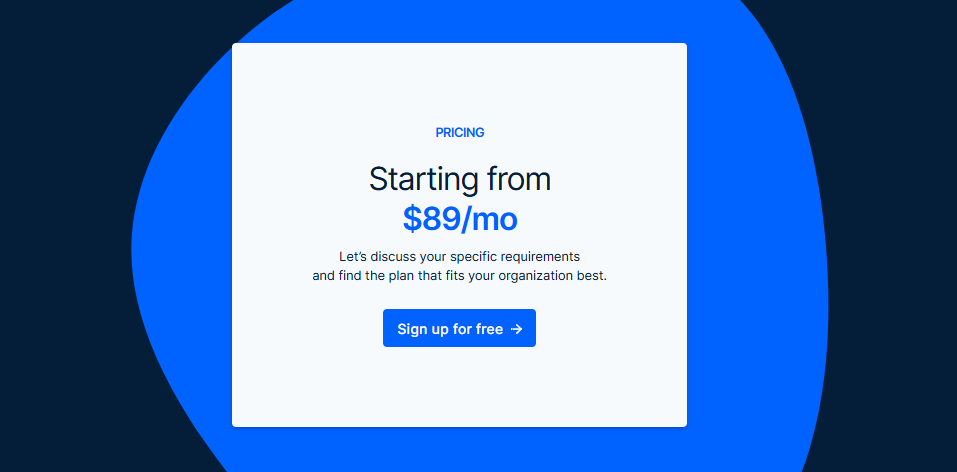
- Pricing starts from $89/month with a 30-day free trial available.
- 0% platform transaction fees (standard Stripe fees apply separately).
- White-label features (custom domain, custom SMTP, full branding) available on Business and Advanced plans.
- Nonprofit discounts available (negotiated individually).
Source: Teachfloor
Use Teachfloor if:
- You’re running bootcamps, accelerators, or certification programs where peer review and group assignments are core to your pedagogy
- You need to scale personalized feedback with AI Review without burning out instructors on hundreds of submissions
- Your program blends live Zoom sessions with asynchronous collaborative activities (Miro, Figma, Google Docs) in one learning environment
7. Circle — Best for Community-Driven Cohort Learning With Workflow Automations
Circle is a community platform that has evolved into a full cohort learning environment, combining structured course delivery with peer accountability mechanisms that traditional course platforms struggle to replicate.
Circle inverts the typical model: it started as a community tool and has added scheduled cohort courses, workflow automation, and AI-powered facilitation on top of its native community foundation.
|
Circle Pros |
Circle Cons |
|---|---|
|
✅ Strongest native community infrastructure in online education |
❌ Transaction fees (0.5-2%) on all plans |
|
✅ Scheduled course format releases content on fixed calendar dates |
❌ No free plan; 14-day trial only |
|
✅ Workflow automations and AI Agents scale facilitation |
❌ AI Agents only on Circle Plus (custom pricing) |
|
✅ 700+ embeddable content types in course lessons |
Circle: Top Features for Cohort Learning
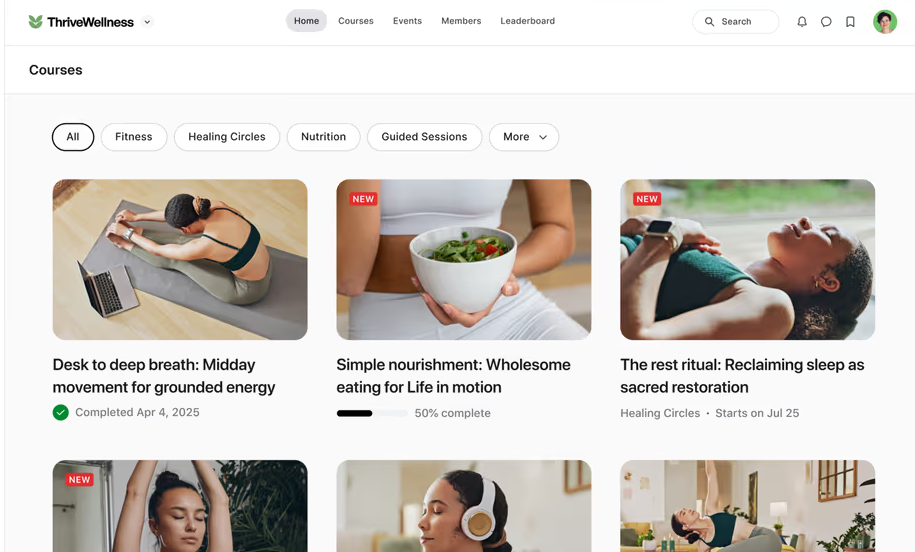
Circle’s scheduled course format releases content on specific calendar dates for all students at once, ensuring every cohort member unlocks the same lesson on the same day. This synchronicity is essential for programs with live Q&As, peer feedback sessions, and group accountability check-ins.
Source: Circle
Workflow automations fire when students join, complete a lesson, or hit milestones, letting facilitators automate onboarding, progress nudges, and re-engagement DMs. Good Inside, with over 100,000 members across 140 countries, uses these automations to maintain a 47% monthly active user rate.
AI Agents (on Circle Plus) answer student questions 24/7, trained on the community’s specific content using Retrieval Augmented Generation. Standard workflows handle welcome sequences, space assignments by cohort, and session reminders. Exit Five used this setup to achieve 43% YoY revenue growth by converting course buyers into long-term community members.
Circle Pricing
All prices reflect annual billing. Transaction fees apply on all payments processed through Circle.
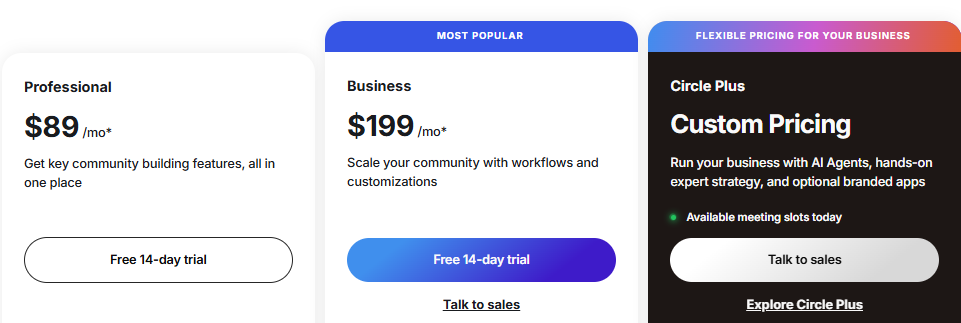
- Professional ($89/month). Unlimited members, courses, events, live streams (100 attendees), gamification. 2% transaction fee.
- Business ($199/month). Workflow automations (20 automations), API access, AI content co-pilot, branded email notifications, remove Circle branding. 1% transaction fee. Optional branded mobile app.
- Circle Plus (custom pricing). AI Agents (up to 10), AI Workflows, unlimited automations, custom SSO, dedicated Customer Success Manager. 0.5% transaction fee.
Source: Circle
Use Circle if:
- You believe course completion is driven by peer accountability and community belonging, and want infrastructure that supports that thesis at scale
- You need scheduled cohort delivery where all students progress on the same calendar dates with automated lifecycle management
- You plan to convert one-time course buyers into long-term community members with recurring revenue
⭐ Create a more engaging online community with Circle using this special link. Bring together discussions, memberships, courses, and live events in one streamlined platform.
Final Verdict
Each platform on this list excels for a specific cohort learning use case. The right choice depends on what role cohort courses play in your broader business:
- Kajabi: If you’re building an expert business where cohort courses sit alongside coaching, community, email marketing, and a website, and you want all of it running from one platform with zero transaction fees. Get started with Kajabi for free for 30 days instead of just 14!
- Thinkific: If you’re launching your first cohort program on a budget and need reliable live lessons, structured assignments, and community without enterprise pricing. Try it free for 30 days.
- Disco: If completion rates directly determine your program’s ROI and you need AI to scale curriculum development and learner support without scaling headcount.
- Mighty Networks: If your cohort model depends on mobile-first community engagement and you want live sessions, recurring events, and peer accountability in a single member experience.
- Maven: If you want to validate a cohort course concept with zero financial risk and tap into a marketplace of 500,000+ learners looking for professional development.
- Teachfloor: If peer review, group assessment, and collaborative evaluation are pedagogical requirements of your program, not optional add-ons.
- Circle: If you want to build a community-driven learning business where cohort courses are the entry point into long-term paid membership.
Best Cohort-Based Course Platforms FAQ
What is a cohort-based course and how is it different from a self-paced course?
A cohort-based course enrolls a group of students who start and progress through the material together on a shared timeline, typically with live sessions, peer interaction, and fixed deadlines. Self-paced courses let students start anytime and move at their own speed.
The key difference is accountability: cohort programs achieve 85-95% completion rates compared to 5-15% for self-paced courses because of the social pressure, live interaction, and structured deadlines built into the format.
Which cohort-based course platform is best for beginners on a budget?
Thinkific offers the most accessible entry point at $82/month (annual) on its Start plan, which includes unlimited live Zoom lessons, structured assignments, and community spaces with 0% platform transaction fees.
Maven is another budget-friendly option since it charges no monthly fee at all; instructors only pay 10% of revenue when a student enrolls, making it free to start.
Can I run a cohort-based course on Kajabi?
Yes. Kajabi has a dedicated cohort-based course format with live video session scheduling, drip content delivery, content locking, community features with gamification, and built-in coaching tools.
The difference is that Kajabi also includes your email marketing, sales funnels, website, and payment processing in the same subscription, so you don’t need separate tools to fill and run your cohort program.
Which platform is best for large-scale corporate training cohorts?
Disco is built for mid-market organizations running cohort programs at scale, with SAML SSO, API/webhooks, dedicated success managers, and AI that reduces instructor workload. Teachfloor is also strong for enterprise use cases, with SOC 2 Type II compliance, SCORM support, and peer review workflows designed for academic and professional certification programs.
Do I need a large audience to launch a cohort-based course?
Not necessarily. Maven’s marketplace provides access to 500,000+ learners and its Lightning Lessons feature helps instructors build an audience from scratch.
For platforms that don’t provide distribution (Kajabi, Thinkific, Circle, etc.), you’ll need to bring your own audience through email marketing, social media, or partnerships, though platforms like Kajabi include the marketing tools to help you build that audience over time.
What completion rates can I expect from a cohort-based course?
Published benchmarks show cohort programs achieving 85-95% completion rates. Disco reports 85-90% across its platform, with specific customers like Kids & Company achieving 85% and Ten More In reaching 90%.
These figures compare to the 5-15% industry average for self-paced online courses. The key drivers are peer accountability, live sessions, and structured timelines rather than any single platform feature.
How much should I charge for a cohort-based course?
Pricing varies widely based on audience, topic, and program depth. Maven’s data suggests $800-$1,200 for programs with 6-8 live hours plus a project, $1,200-$1,800 for 8-12 hours with multiple projects, and $1,800-$2,450 for comprehensive 12-20 hour programs with capstone projects.
The key factor is the transformation you deliver and the accountability structure you provide, both of which justify premium pricing relative to self-paced alternatives.
Which platform is best if I want to combine cohort courses with ongoing community membership?
Circle and Mighty Networks are both designed for this model. Circle’s architecture supports the “audience to member” journey where a cohort course is the entry point into a long-term paid community. Mighty Networks integrates courses directly into community spaces so cohort graduates naturally transition into ongoing membership.
Kajabi also supports this model with its combined course and community products, plus the benefit of managing the entire membership billing and email communication natively.